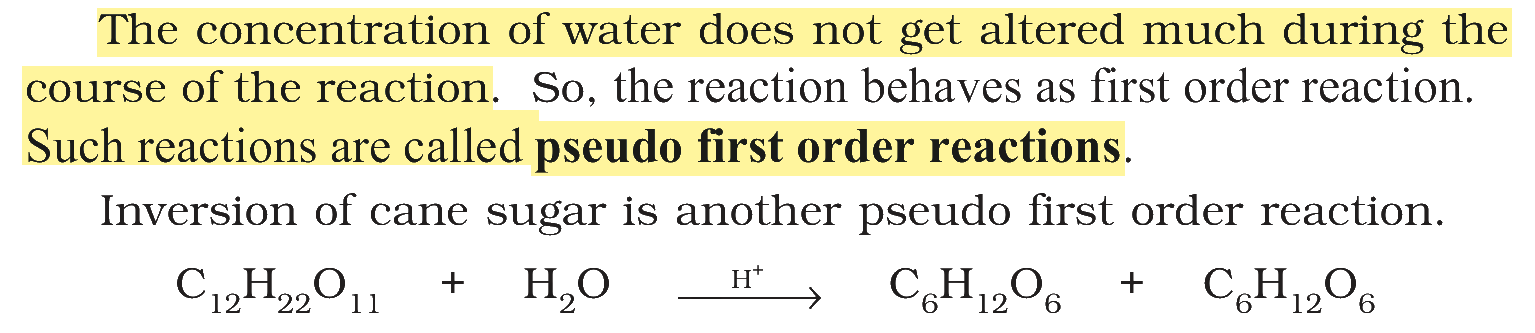
Inversion or hydrolysis of cane sugar (in presence of excess of water) i.e.
C12H22O11 + H2O → C6H12O6 + C6H12O6
Cane Sugar Glucose Fructose
is a pseudo first order reaction with Rate = k [C12H22O11]
Which of the following statements is correct about this pseudo-first order reaction?
Answer & explanation
Correct answer: option 1
The correct answer is Option (1) → The rate of inversion of cane sugar is affected by its concentration.
A pseudo first order reaction has two reactants, but one of them is present in such a large excess that its concentration hardly changes during the reaction. That concentration can be treated as a constant and absorbed into the rate constant, so the rate depends on the other reactant alone.
In the inversion of cane sugar, water is present in large excess:
\( \displaystyle \text{Rate}=k^{\prime}[\mathrm{C_{12}H_{22}O_{11}}][\mathrm{H_2O}] \)
\( \displaystyle [\mathrm{H_2O}]\approx\text{constant}\ \Rightarrow\ k=k^{\prime}[\mathrm{H_2O}] \)
\( \displaystyle \text{Rate}=k[\mathrm{C_{12}H_{22}O_{11}}] \)
So the rate of inversion depends on the concentration of cane sugar. Acid hydrolysis of an ester in excess water is another example of the same kind.
Why the other options are incorrect
Option (2) The rate of inversion of cane sugar increases as time progresses. — Incorrect. Cane sugar is used up as the reaction proceeds, so its concentration falls and the rate decreases with time.
Option (3) The rate of inversion of cane sugar depends on the concentration of water. — Incorrect. Water is in such large excess that the rate is practically independent of its concentration. This is what makes the reaction pseudo first order.
Option (4) Concentration of water is much altered during the reaction. — Incorrect. Only a tiny fraction of the water is consumed, so its concentration stays almost constant.
NCERT (2026-27 edition):
Half-Life of a Reaction – …