
CUETMOCK
  • Pricing
  • Mentors
Log inStart freeStart free mocks→

First test, then trust

Try a free CUET mock test.

Join 5,00,000+ students who rehearsed exam day on the exact NTA screen before sitting CUET. On the web and on Android.

Start free mocks →Get the Android app
CUETMOCK

India's #1 CUET Mock Test Platform. Original NCERT-based questions on the exact NTA exam screen — trusted by 5,00,000+ students since CUET 2022.

Get it onGoogle PlayScan to download the CUETMOCK app

Mock tests

  • CUET mock test series
  • Commerce mocks
  • Humanities (Arts) mocks
  • Science mocks
  • Languages & GAT mocks
  • Free practice questions
  • Pricing

Resources

  • CUET exam guide
  • CUET syllabus
  • Universities accepting CUET
  • Expert blogs
  • News & notifications
  • Webinars & counselling
  • CUET score calculator
  • How we estimate your rank
  • FAQs

Company

  • About us
  • Our leadership & team
  • Our toppers
  • Mentors
  • For schools
  • Contact us
  • Terms
  • Privacy
  • Refund policy

Talk to us

+91 7696 6630 56info@cuetmock.comWhatsApp us

Our other platforms

  • JEE Mock — For IIT-JEE aspirants
  • NEET Mock — For NEET aspirants

Newsletter

Exam updates, study material and offers — no spam.

© 2026 NYC Ventures Pvt. Ltd.

701-702, Royal Business Park, Zirakpur, Punjab - 140603

  • Terms of use
  • Privacy policy
  • Refund policy
  • Contact us

iCUETMOCK is an independent preparation platform, not affiliated with the National Testing Agency (NTA). Always check exam details on the official NTA website.

  • Home
  • Mock tests
  • CUET guide
  • Pricing
  • Log in
Home/Practice questions/Chemistry
ChemistryInorganic: D and F Block Elements

Which one of the following ions is colourless in aqueous solution?

Which one of the following ions is colourless in aqueous solution?

Answer & explanation+

Correct answer: option 4

The correct answer is Option (4) → Zn2+

A transition metal ion is coloured when a d electron can be excited from a lower to a higher energy d orbital by absorbing visible light. This needs a partly filled d subshell; an ion with 3d0 or 3d10 cannot do it and is colourless.

  • Configuration of Zn: Z = 30, [Ar]3d104s2.

  • Electrons removed: the two 4s electrons, giving \( \ce{Zn^2+} \): 3d10.

  • Result: the 3d subshell is full, so no d–d transition is possible and \( \ce{Zn^2+} \) is colourless.

Why the other options are incorrect

Option (1) Ti3+ — Incorrect. Ti (Z = 22) is [Ar]3d24s2; \( \ce{Ti^3+} \) is 3d1, and its aqueous solution is purple.

Option (2) Cu2+ — Incorrect. Cu (Z = 29) is [Ar]3d104s1; \( \ce{Cu^2+} \) is 3d9, and its aqueous solution is blue.

Option (3) Ni2+ — Incorrect. Ni (Z = 28) is [Ar]3d84s2; \( \ce{Ni^2+} \) is 3d8, and its aqueous solution is green.

NCERT (2026-27 edition):
4.3.10 Formation of Coloured Ions – “When an electron from a lower energy d orbital is excited to a higher energy d orbital, the energy of excitation corresponds to the frequency of light absorbed (Unit 5). This frequency generally lies in the visible region. … In aqueous solutions where water molecules are the ligands, the colours of the ions observed are listed in Table 4.8.”

Table 4.8: Colours of Some of the First Row (aquated) Transition Metal Ions
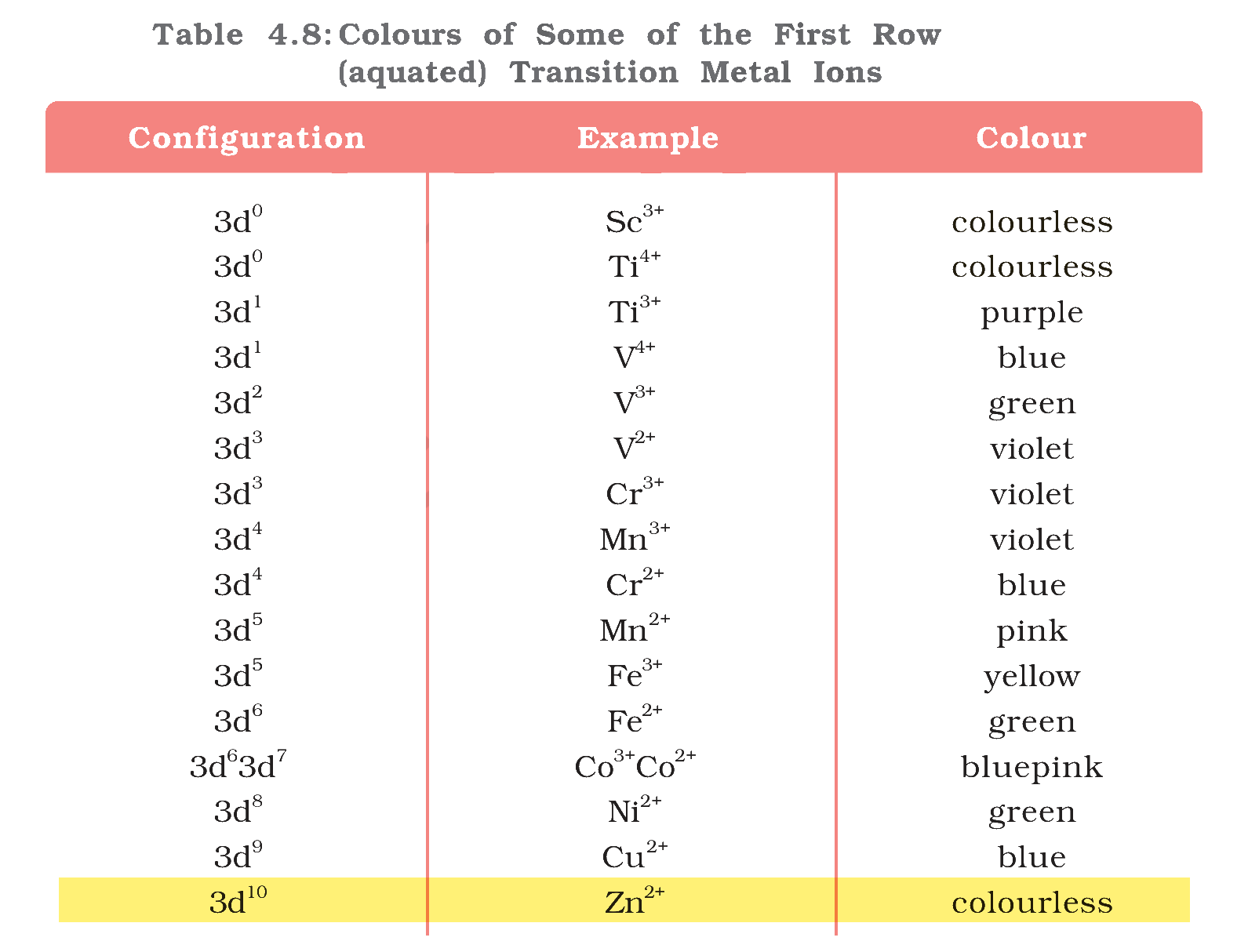
Table 4.8

Advertisement

Practise more on Inorganic: D and F Block Elements

Chapter-wise mocks on the real NTA exam screen, with solutions and your rank. Your first mocks are free.

Start free mocks →

Advertisement

Next questions

  1. A firm under perfect competition has a minimum AVC of Rs 40 in the short run. Its minimum SAC and its minimum LRAC are both Rs 50. The mark…Economics · Micro Economics: Theory of Firms under Perfect Competition
  2. If the selling price of an article is 25% of its cost price, then what will be the loss percentage?General Aptitude Test · Numerical Ability
  3. Suresh for 2 years invested Rs. 500 in SBI. He also invested Rs. 300 in ICICI for 4 years. At the end he received Rs. 220 from both banks a…General Aptitude Test · Numerical Ability
  4. Amir Khusrau was a disciple of which sufi saint?History · Medieval India: Bhakti Sufi Traditions
  5. Match List-I with List-II.List-IList-II(A)Average propensity to save(I)Inversely related to investment multiplier(B)Average propensity to c…Economics · Macro Economics: Determination of Income and Employment
  6. Which is a reason for less stability of RNA in comparison to DNA? (Question 4)Biology · Molecular Basis of Inheritance
  7. Which of the following crop is shown in the shaded area in the map given below?Geography · India-People and Economy: Land resources and Agriculture
  8. Select the option in which the number set shares the same relationship as that shared by the given number set. (6, 42, 1890)General Aptitude Test · General Ability
  9. The question below is followed by two statements numbered I and II. Choose the option that describes whether the statements are sufficient…General Aptitude Test · Verbal Reasoning
  10. Simplify ≤ft((x^m)/(x^n))^m+n·≤ft((x^n)/(x^p))^n+p·≤ft(x^p× x^m)^p-mGeneral Aptitude Test · Quantitative Reasoning