
CUETMOCK
  • Pricing
  • Mentors
Log inStart freeStart free mocks→

First test, then trust

Try a free CUET mock test.

Join 5,00,000+ students who rehearsed exam day on the exact NTA screen before sitting CUET. On the web and on Android.

Start free mocks →Get the Android app
CUETMOCK

India's #1 CUET Mock Test Platform. Original NCERT-based questions on the exact NTA exam screen — trusted by 5,00,000+ students since CUET 2022.

Get it onGoogle PlayScan to download the CUETMOCK app

Mock tests

  • CUET mock test series
  • Commerce mocks
  • Humanities (Arts) mocks
  • Science mocks
  • Languages & GAT mocks
  • Free practice questions
  • Pricing

Resources

  • CUET exam guide
  • CUET syllabus
  • Universities accepting CUET
  • Expert blogs
  • News & notifications
  • Webinars & counselling
  • CUET score calculator
  • How we estimate your rank
  • FAQs

Company

  • About us
  • Our leadership & team
  • Our toppers
  • Mentors
  • For schools
  • Contact us
  • Terms
  • Privacy
  • Refund policy

Talk to us

+91 7696 6630 56info@cuetmock.comWhatsApp us

Our other platforms

  • JEE Mock — For IIT-JEE aspirants
  • NEET Mock — For NEET aspirants

Newsletter

Exam updates, study material and offers — no spam.

© 2026 NYC Ventures Pvt. Ltd.

701-702, Royal Business Park, Zirakpur, Punjab - 140603

  • Terms of use
  • Privacy policy
  • Refund policy
  • Contact us

iCUETMOCK is an independent preparation platform, not affiliated with the National Testing Agency (NTA). Always check exam details on the official NTA website.

  • Home
  • Mock tests
  • CUET guide
  • Pricing
  • Log in
Home/Practice questions/Biology
BiologyOrganisms and Populations

The Verhulst-Pearl Logistic Growth is described by which equation?

The Verhulst-Pearl Logistic Growth is described by which equation?

Answer & explanation+

Correct answer: option 1

The correct answer is Option (1) → \(\frac{dN}{dt}\) = rN(\(\frac{K-N}{K}\))

No population in nature has unlimited resources. A population in a habitat with limited resources grows slowly at first, then faster, then slower, and finally levels off at the carrying capacity K. This sigmoid growth is called Verhulst-Pearl Logistic Growth. In its equation the growth rate rN is multiplied by (K – N)/K, the share of the carrying capacity still unused. As N comes close to K, this share falls towards zero and growth stops.

Option (1) \(\frac{dN}{dt}\) = rN(\(\frac{K-N}{K}\)) — Correct. This is the logistic equation. When N is small, (K – N)/K is close to 1 and growth is almost exponential; when N reaches K, it becomes zero.

Option (2) \(\frac{dN}{dt}\) = rN(\(\frac{K+N}{K}\)) — Incorrect. With (K + N)/K the factor grows larger as N rises, so the population would speed up instead of levelling off at K.

Option (3) \(\frac{dN}{dt}\) = rN(\(\frac{K}{K-N}\)) — Incorrect. With K/(K – N) the factor rises without limit as N approaches K. This is the opposite of the slowing down seen in logistic growth.

Option (4) \(\frac{dN}{dt}\) = rK(\(\frac{K-N}{N}\)) — Incorrect. It multiplies r by K instead of by N and divides by N instead of by K, so growth would be fastest when the population is smallest. This is not the book’s equation.

NCERT Extract:
Growth Models – “… In nature, a given habitat has enough resources to support a maximum possible number, beyond which no further growth is possible. Let us call this limit as nature’s carrying capacity (K) for that species in that habitat. … A plot of N in relation to time (t) results in a sigmoid curve. This type of population growth is called Verhulst-Pearl Logistic Growth (Figure 11.3) and is described by the following equation:” \(\frac{dN}{dt} = rN\left(\frac{K-N}{K}\right)\)
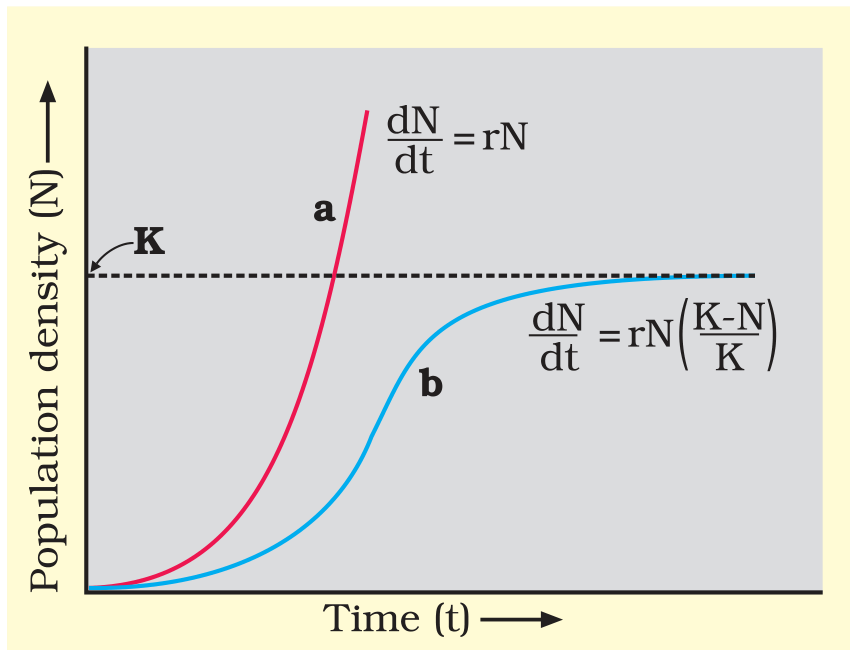
Textbook figure

Figure 11.3 Population growth curve: a when responses are not limiting the growth, plot is exponential; b when responses are limiting the growth, plot is logistic; K is carrying capacity

Advertisement

Practise more on Organisms and Populations

Chapter-wise mocks on the real NTA exam screen, with solutions and your rank. Your first mocks are free.

Start free mocks →

Advertisement

Next questions

  1. Identify the sentence which has the correct use of the underlined word.English · Grammar: Adjective
  2. In the series given below, one number does not fit. Find that number. 2, 5, 12, 27, 57, 121, 248General Aptitude Test · Verbal Reasoning
  3. A piece of iron is heated in a flame. It first become dull red then becomes reddish yellow and finally turns to white hot. The correct expl…Physics · Thermodynamics
  4. Women emerging as the main source of agricultural labour is leading to:Sociology · Social Change and Development in India: Change and Development in Rural Society
  5. In a code language,if 'she was working’ is written as '592', 'I was curious’ is written as '267', and 'she is curious' is written as '987',…General Aptitude Test · Verbal Reasoning
  6. Rearrange the following jumbled phrases into a coherent sentence.A. as Annu is senior to Susan B. though Susan had worked there before Annu…English · Arrange in Meaningful Sequence
  7. Which of the following numbers is a prime number?General Aptitude Test · Numerical Ability
  8. If, vec a,vec b,vec c,vec d are any four vectors, then (vec a×vec b) × (vec c×vec d) is a vectorMaths. Section B1 · Vectors
  9. Chemistry · Organic: Haloalkanes and Haloarenes
  10. If + means x, + means x and - means +, what will be the value of 1 + 20 + 10 - 5 = ?General Aptitude Test · Verbal Reasoning