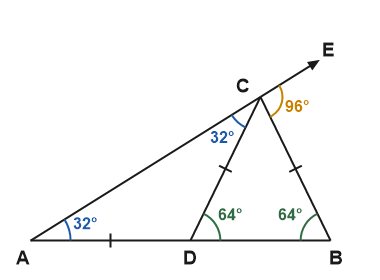
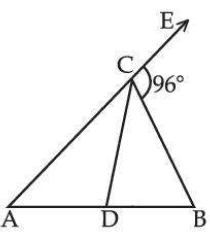
In the given figure, if \(AD=CD=BC\), then the \(∠CDB\) is:
Answer & explanation
Correct answer: option 1
The correct answer is Option (1) → 64°
Two facts settle it: equal sides face equal angles, and an exterior angle of a triangle equals the sum of the two opposite interior angles. Let \(\angle CAD=x\).
AD \(=\) CD, so in triangle ACD, \(\angle ACD=\angle CAD=x\)
\(\angle CDB\) is the exterior angle of triangle ACD at D: \(\angle CDB=x+x=2x\)
CD \(=\) BC, so in triangle CDB, \(\angle CBD=\angle CDB=2x\)
\(\angle ECB=96^\circ\) is the exterior angle of triangle ABC at C: \(x+2x=96^\circ\), so \(x=32^\circ\)
\(\angle CDB=2x=64^\circ\)