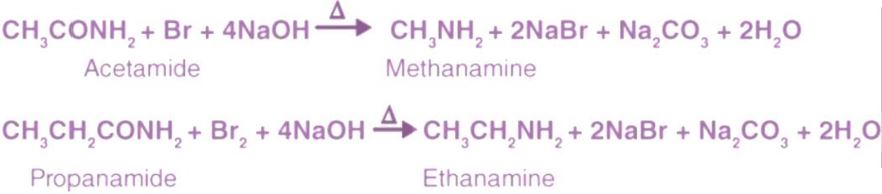
The reaction shown above is known as
Answer & explanation
Correct answer: option 4
The correct answer is Option (4) → Hoffmann bromamide degradation reaction
The given reaction involves the conversion of an amide (R–CONH₂) into a primary amine (R–NH₂) using bromine (Br₂) and a strong base (NaOH).
During this reaction:
- One carbon atom from the amide group is removed as carbonate (Na₂CO₃)
- The product amine has one carbon atom less than the original amide
General reaction:
R–CONH₂ + Br₂ + 4NaOH → R–NH₂ + Na₂CO₃ + 2NaBr + 2H₂O
This reaction is known as the Hoffmann bromamide degradation reaction (also called Hofmann rearrangement).
Key features of this reaction:
- Conversion of amide to primary amine
- Loss of one carbon atom
- Reaction occurs in alkaline medium with bromine
Option-wise Explanation
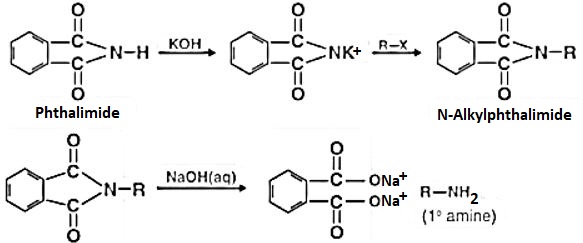
Option 1: Gabriel phthalimide synthesis
This reaction is used to prepare primary amines from alkyl halides using phthalimide. It does not involve bromine and NaOH reacting with amides. Therefore this option is incorrect.
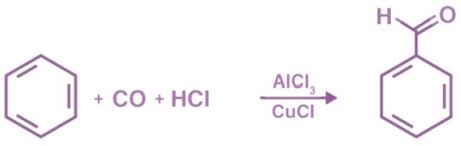
Option 2: Gattermann reaction
The Gattermann reaction involves the substitution of diazonium salts with halogens or other groups using copper powder. It is unrelated to the conversion of amides to amines. Hence this option is incorrect.
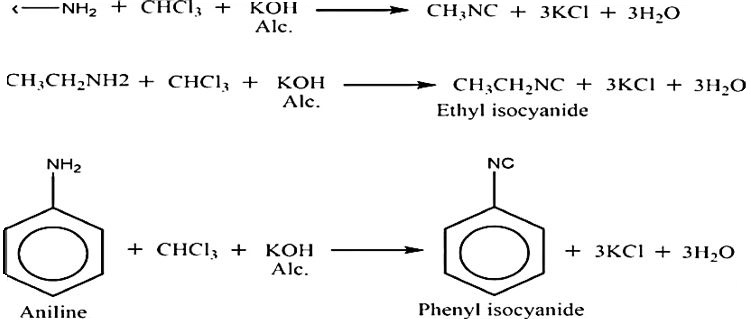
Option 3: Carbylamine reaction
The carbylamine reaction involves primary amines reacting with chloroform and alcoholic KOH to produce isocyanides. Since the given reaction converts an amide to an amine, it is not a carbylamine reaction. Therefore this option is incorrect.
Option 4: Hoffmann bromamide degradation reaction
This reaction specifically describes the conversion of amides into primary amines with one carbon atom less using bromine and sodium hydroxide. The equation given in the question exactly matches this reaction. Hence this option is correct.