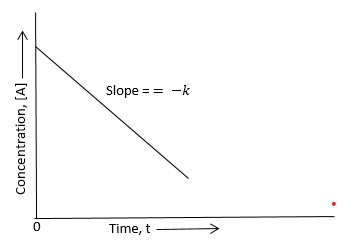
For a zero-order reaction, the plot of concentration vs time is linear with:
Answer & explanation
Correct answer: option 4
The correct answer is option 4. –ve slope and non-zero intercept.
Consider the general reaction:
\(A \rightarrow Products\)
If it is a reaction of zero order, then the rate of reaction will be
\(−\frac{d[A]}{dt} = k[A]^o\)
or, \(−\frac{d[A]}{dt}= k\) \([Since, [A]^o = 1]\)
or, \(d[A] = −kdt\)-----------------(i)
Integrating both sides, we get
\(\int{d[A]} = −k \int{dt}\)
or, \([A] = −kt + c\) ---------------(ii)
where, \(c\) is the constant of integration
At
\(t = 0, [A] = [A]_o\)
\(∴ [A]_o = c\)
Substituting this value in equation (i), we get
\([A] = −kt + [A]_o\)
or, \(kt = [A]_o − [A]\)
or, \(k = \frac{1}{t}{[A]_o − [A]}\) ---------------(iii)
This is the expression for rate constant for reactions of zero order.
From zero order reaction, we have
\([A] = −kt + [A]_o\)
As it is in the form of a straight line, \(y = mx + c\) , where, slope, \(m = − k\) and the intercept, \(c =[A]_o\). So the plot of concentration, [A] versus time, t will be