
Acetaldehyde on treatment with Fehling's solution gives a precipitate of
Answer & explanation
Correct answer: option 1
The correct answer is Option (1) → $Cu_2O$
Fehling's solution is used to distinguish aldehydes from ketones. Aliphatic aldehydes reduce $Cu^{2+ }$ ions to Cut ions forming a brick-red precipitate of cuprous oxide.
Oxidation of aldehydes with Fehling's solution -
- Fehling solution A is aqueous copper sulphate,
Fehling solution B is alkaline sodium potassium tartrate (Rochelle salts)
- Distinguished aldehydes from ketones.
- wherein
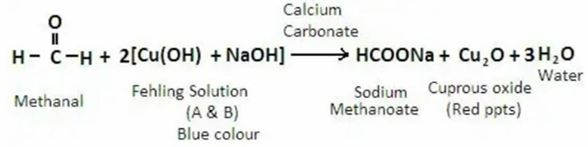
$CH_3CHO$ + Fehling's solution $Cu_2$O (Red ppt.)
Explanation
Option 1: $Cu_2O$
Acetaldehyde is an aliphatic aldehyde and reduces Fehling's solution. In this reaction, $Cu^{2+}$ ions are reduced to $Cu^+$ forming a red precipitate of cuprous oxide. This confirms the presence of an aldehyde group.
Option 2: Cu
Metallic copper is not formed in this reaction. The reduction stops at the cuprous oxide stage rather than forming elemental copper.
Option 3: CuO
CuO is copper(II) oxide and represents the oxidized form of copper. Fehling's solution actually undergoes reduction, not oxidation, so this product is not formed.
Option 4: $Cu_2O_2$
This is not a stable or commonly formed product in Fehling's test. The characteristic precipitate is specifically cuprous oxide.