CUETMOCK
  • Pricing
  • Mentors
Log inStart freeStart free mocks→

First test, then trust

Try a free CUET mock test.

Join 5,00,000+ students who rehearsed exam day on the exact NTA screen before sitting CUET. On the web and on Android.

Start free mocks →Get the Android app
CUETMOCK

India's #1 CUET Mock Test Platform. Original NCERT-based questions on the exact NTA exam screen — trusted by 5,00,000+ students since CUET 2022.

Get it onGoogle PlayScan to download the CUETMOCK app

Mock tests

  • CUET mock test series
  • Browse all papers
  • Commerce mocks
  • Humanities (Arts) mocks
  • Science mocks
  • Languages & GAT mocks
  • Free practice questions
  • Pricing

Resources

  • CUET exam guide
  • CUET syllabus
  • Universities accepting CUET
  • Expert blogs
  • News & notifications
  • Webinars & counselling
  • CUET score calculator
  • How we estimate your rank
  • FAQs

Company

  • About us
  • Our leadership & team
  • Our toppers
  • Mentors
  • For schools
  • Contact us
  • Terms
  • Privacy
  • Refund policy

Talk to us

+91 7696 6630 56info@cuetmock.comWhatsApp us

Our other platforms

  • JEE Mock — For IIT-JEE aspirants
  • NEET Mock — For NEET aspirants

Newsletter

Exam updates, study material and offers — no spam.

© 2026 NYC Ventures Pvt. Ltd.

701-702, Royal Business Park, Zirakpur, Punjab - 140603

  • Terms of use
  • Privacy policy
  • Refund policy
  • Contact us

iCUETMOCK is an independent preparation platform, not affiliated with the National Testing Agency (NTA). Always check exam details on the official NTA website.

  • Home
  • Mock tests
  • CUET guide
  • Pricing
  • Log in
Home/Practice questions/General Aptitude Test
General Aptitude TestQuantitative ReasoningGeometry

In ΔABC, BD is the internal bisector of ∠B meeting AC at D. If CD = 7…

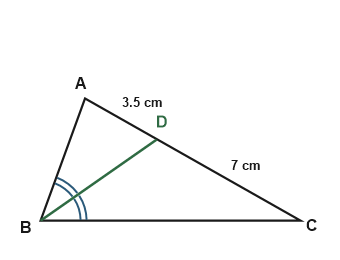
In ΔABC, BD is the internal bisector of ∠B meeting AC at D. If CD = 7 cm and AC = 10.5 cm, then AB : BC is

Answer & explanation+

Correct answer: option 2

The correct answer is Option (2) → 1 : 2

By the angle bisector theorem, the bisector of an angle of a triangle divides the opposite side in the ratio of the other two sides: \(\displaystyle\frac{AB}{BC}=\frac{AD}{DC}\). So the two parts of AC give the ratio at once.

  • D lies on AC, so the part AD is \(AC-CD=10.5-7=3.5\) cm

  • Then \(AB:BC=AD:DC=3.5:7=1:2\)

Figure for the solution

Advertisement

Practise more on Quantitative Reasoning

Chapter-wise mocks on the real NTA exam screen, with solutions and your rank. Your first mocks are free.

Start free mocks →

Advertisement

Next questions

  1. A thief is noticed by a policeman from a distance of 200 m. The thief starts running and the policeman chases him. The thief and the police…General Aptitude Test · Numerical Ability
  2. In a certain code language, ‘DECENT’ is coded as ‘VPGEGF’. What is the code for ‘ENERGY’ in that code language?General Aptitude Test · Verbal Reasoning
  3. Identify the correct sequence of staffing process. (A) Training & development (B) Recruitment & selection (C) Estimating the manpower requi…Business Studies · Staffing
  4. In which year did the USA gain its independence?Political Science · Contemporary World Politics: US Hegemony in World Politics
  5. Choose the sentence that uses the correct question tag:English · Grammar: Question Tags
  6. If ( a + b + c) = 7 and ab + bc + ca = 12, find the value of a^2 +b^2 +c^2.General Aptitude Test · Quantitative Reasoning
  7. Read the given statements and conclusions carefully. Assuming that the information given in the statements is true, even if it appears to b…General Aptitude Test · Verbal Reasoning
  8. Identify the voice and tense of the underlined verb:The NSS volunteers have been preparing the stage for the cultural night since morning.English · Grammar: Active Passive Voice
  9. Match the following thinkers (List-I) with their major ideas (List-II). List-I (Thinker) List-II (Idea) (A) Harry Braverman (I) Work is bro…Sociology · Social Change and Development in India: Change and Development in industrial Society
  10. Shares can be forfeited:Accountancy Part A · Accounting for Shares