
A linear programming problem (LPP) along with the graph of its constraints is shown below. The corresponding objective function is: Minimise: $Z = 3x + 2y$. The minimum value of the objective function is obtained at the corner point $(2, 0)$.
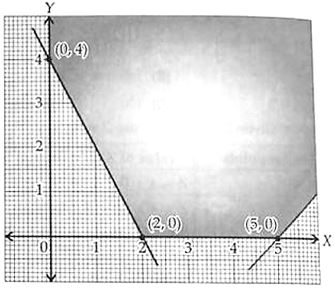
The optimal solution of the above linear programming problem ............
Answer & explanation
Correct answer: option 4
The correct answer is Option (4) → exists as the inequality $3x + 2y < 6$ does not have any point in common with the feasible region. ##
The feasible region is bounded, with the minimum of $Z = 3x + 2y$ at $(2, 0)$.
The inequality $3x + 2y < 6$ has no common points with the feasible region, as the line $3x + 2y = 6$ lies entirely outside it.
Since the region is bounded and linear, the optimal solution must occur at a corner point.