
Answer the question on basis of passage given below:
Organic compounds containing carbon-oxygen double bonds (C=O) are called carbonyl compounds. These are highly polar molecules. Hence, their boiling points are higher than hydrocarbons and ethers. Aldehydes can be prepared from dehydrogenation or oxidation of alcohols and by reduction of acyl halides. Ketones are prepared by oxidation of secondary alcohols or by hydration of alkynes etc. Aldehydes and ketones undergo nucleophilic addition reaction with a number of nucleophiles such as HCN, NaHSO3, ammonia derivatives. Carboxylic acids are prepared by the oxidation of primary alcohols, aldehydes and alkenes, by hydrolysis of nitriles. Carboxylic acids are more acidic than alcohols and phenols.
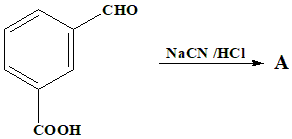
The product (A) is:
Answer & explanation
Correct answer: option 2
The correct answer is Option (2) → 3-[CH(OH)CN]C6H4COOH (cyanohydrin at the former CHO group)
NaCN with HCl generates HCN, and the cyanide ion adds to the carbonyl carbon of an aldehyde (nucleophilic addition) to give a cyanohydrin, >C(OH)CN. The carbonyl of a –COOH group does not undergo this addition: its C=O is stabilised by resonance with the –OH oxygen and is far less electrophilic.
So in 3-formylbenzoic acid only the –CHO group reacts and the –COOH group is unchanged:
3-\( \ce{OHC-C6H4-COOH} \) + HCN → 3-\( \ce{[NC-CH(OH)]-C6H4-COOH} \)
This is the structure in Option (2).
Why the other options are incorrect
Option (1) — Incorrect. Benzene-1,3-dicarboxylic acid would need the CHO group to be oxidised; NaCN/HCl is not an oxidising agent.
Option (3) — Incorrect. A \( \ce{CH2OH} \) group is the product of reducing the CHO group (for example with \( \ce{NaBH4} \)), not of adding HCN.
Option (4) — Incorrect. It shows the cyanohydrin formed at the carbon of the –COOH group with the CHO group left intact; carboxylic acids do not add HCN, so this cannot form.
NCERT (2026-27 edition):
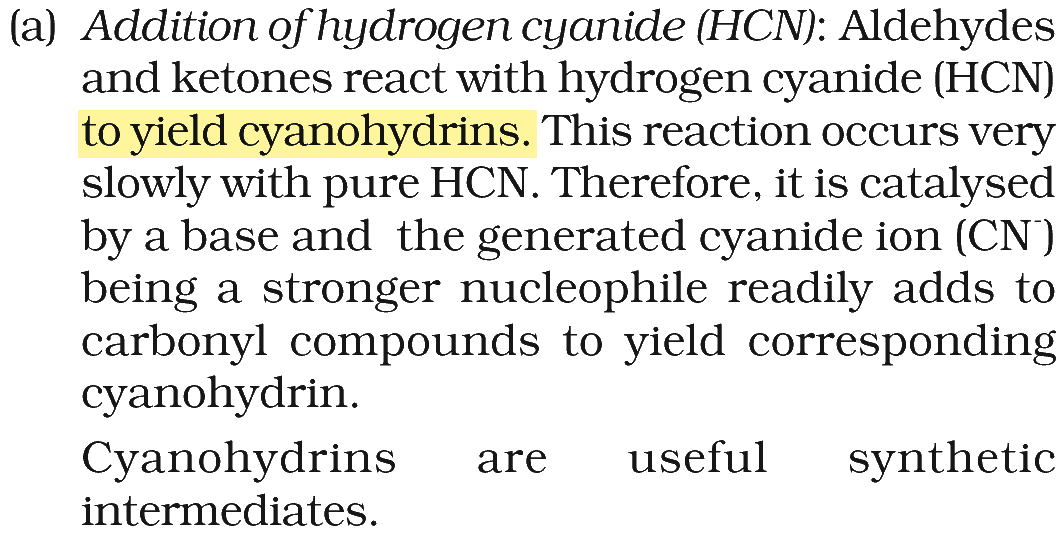
Addition of Hydrogen Cyanide (HCN)
Note: The same/similar question has been asked in different years by NTA as per the details given below:
| 2026 | 2025 | 2024 | 2023 | 2022 |
|---|---|---|---|---|
| – | – | – | 09-06 S3 07-06 S3 | – |