
CUETMOCK
  • Pricing
  • Mentors
Log inStart freeStart free mocks→

First test, then trust

Try a free CUET mock test.

Join 5,00,000+ students who rehearsed exam day on the exact NTA screen before sitting CUET. On the web and on Android.

Start free mocks →Get the Android app
CUETMOCK

India's #1 CUET Mock Test Platform. Original NCERT-based questions on the exact NTA exam screen — trusted by 5,00,000+ students since CUET 2022.

Get it onGoogle PlayScan to download the CUETMOCK app

Mock tests

  • CUET mock test series
  • Browse all papers
  • Commerce mocks
  • Humanities (Arts) mocks
  • Science mocks
  • Languages & GAT mocks
  • Free practice questions
  • Pricing

Resources

  • CUET exam guide
  • CUET syllabus
  • Universities accepting CUET
  • Expert blogs
  • News & notifications
  • Webinars & counselling
  • CUET score calculator
  • How we estimate your rank
  • FAQs

Company

  • About us
  • Our leadership & team
  • Our toppers
  • Mentors
  • For schools
  • Contact us
  • Terms
  • Privacy
  • Refund policy

Talk to us

+91 7696 6630 56info@cuetmock.comWhatsApp us

Our other platforms

  • JEE Mock — For IIT-JEE aspirants
  • NEET Mock — For NEET aspirants

Newsletter

Exam updates, study material and offers — no spam.

© 2026 NYC Ventures Pvt. Ltd.

701-702, Royal Business Park, Zirakpur, Punjab - 140603

  • Terms of use
  • Privacy policy
  • Refund policy
  • Contact us

iCUETMOCK is an independent preparation platform, not affiliated with the National Testing Agency (NTA). Always check exam details on the official NTA website.

  • Home
  • Mock tests
  • CUET guide
  • Pricing
  • Log in
Home/Practice questions/Biology
BiologyEcosystem

Select the correct sequence of development of following stages in a p…

Select the correct sequence of development of following stages in a primary succession

A. Scrub Stage

B. Marsh-meadow stage

C. Submerged free floating plant stage

D. Reed-swamp stage

E. Submerged plant stage

Choose the correct answer from the options given below

Answer & explanation+

Correct answer: option 2

The correct answer is Option (2) → E, C, D, B, A

E. Submerged plant stage — first of the five. After the phytoplankton (the pioneers in water), rooted plants that stay under water come up. Their dead parts add soil to the bottom of the pond.

C. Submerged free floating plant stage — second. As the water becomes shallower, plants that float on the surface take over. Their roots hang in the water.

D. Reed-swamp stage — third. The pond is now shallow enough for tall reeds rooted in mud, with stems and leaves above the water.

B. Marsh-meadow stage — fourth. The water body has largely filled up. Sedges and grasses grow on the wet, marshy land.

A. Scrub Stage — last of the five. On the drier land shrubs grow, and in time they give way to trees, the climax forest.

Note: This question is from the topic “Succession of Plants” in Chapter 14, Ecosystem, of the pre-rationalised NCERT book. This portion is not in the present NCERT book, where the chapter is now Chapter 12, Ecosystem. The extract below is from the pre-rationalised edition.

NCERT Extract (Pre-rationalised edition, Chapter 14, Ecosystem):
Succession of Plants – “… In primary succession in water, the pioneers are the small phytoplanktons, which are replaced with time by rooted-submerged plants, rooted-floating angiosperms followed by free-floating plants, then reedswamp, marsh-meadow, scrub and finally the trees. The climax again would be a forest. With time the water body is converted into land (Figure 14.5).”
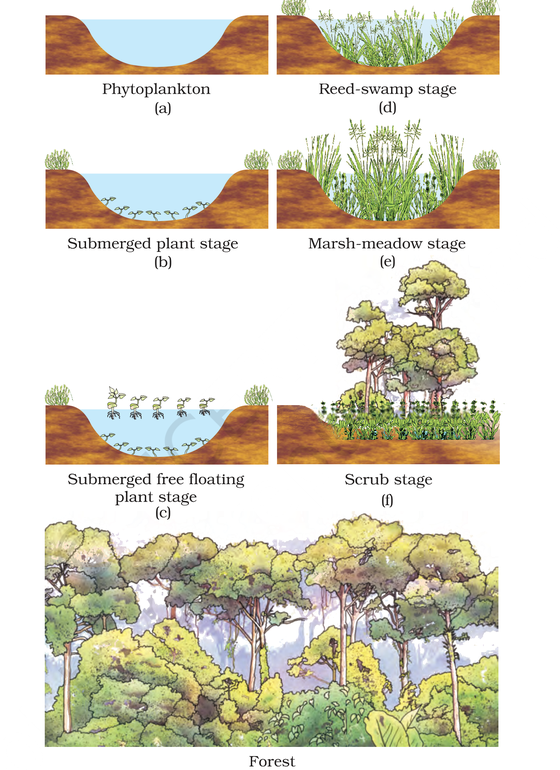
Textbook figure

Advertisement

Practise more on Ecosystem

Chapter-wise mocks on the real NTA exam screen, with solutions and your rank. Your first mocks are free.

Start free mocks →

Advertisement

Next questions

  1. A bag contains 3 red, 7 green and 4 yellow balls. Four balls are drawn together at random. What is the probability that at least 3 of the f…General Aptitude Test · Quantitative Reasoning
  2. Which among the following is related to poultry farm ?Biology · Strategies for enhancement in Food production
  3. Efficiency is increased when for the same benefit or outputs ______.Business Studies · Nature and significance of Management
  4. Which gene controls beta thalassemia?Biology · Principles of Inheritance and Variation
  5. What option was given by the Britishers to the rulers of the princely state that threatened the unity of the newly created India?Political Science · Politics in India Since Independence: Challenges of nation Building
  6. Rakesh, Amit and Suresh started a business. Rakesh invested 1/2 part, Amit 1/3 part and rest of the capital was invested by Suresh. The rat…General Aptitude Test · Numerical Ability
  7. In an eighteenth-century Bengal village, a zamindar pays the village carpenter a small daily allowance and diet money for his work. This ki…History · Medieval India: Peasants, Zamindars and the State
  8. A borrowed a loan from B at 5% p.a. simple interest for 3 years and repaid the loan amount Rs.26450 with interest. The amount of loan taken…General Aptitude Test · Numerical Ability
  9. Read the given statements and conclusions carefully. Assuming that the information given in the statements is true, even if it appears to b…General Aptitude Test · Verbal Reasoning
  10. Match List-I with List-IIList-IList-IILinesDirection Ratios(A) 2x+3=y+1=z-1 (I) −1, 2, 0(B) (1-2x)/2=displaystyley/2,z=2 (II) 1, 1, 1(C) x=…Maths. Section B1 · Three-dimensional Geometry