
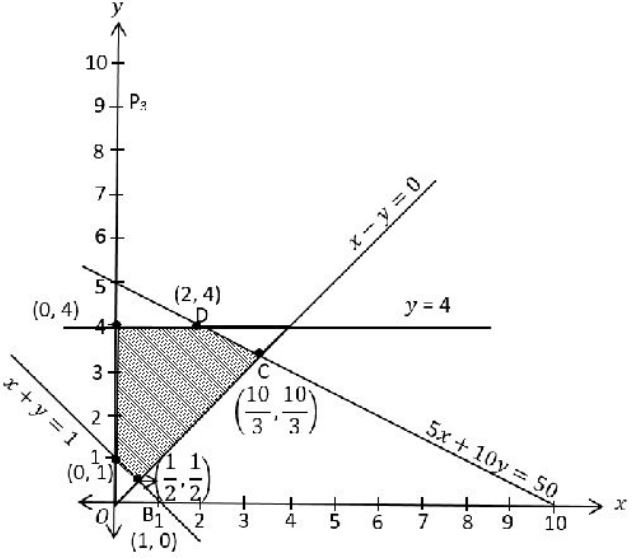
As per the below-mentioned graph of shaded bounded feasible region of the LPP, the maximum value of the objective function \(z = 2x + y\) is
Answer & explanation
Correct answer: option 3
The correct answer is Option (3) → 10
By the corner point method, the maximum of z over a bounded feasible region occurs at a corner point. The corner points marked on the graph give:
\( (0, 1):\ z = 2(0) + 1 = 1 \)
\( (0, 4):\ z = 2(0) + 4 = 4 \)
\( (2, 4):\ z = 2(2) + 4 = 8 \)
\( \displaystyle \left(\frac{1}{2}, \frac{1}{2}\right):\ z = 2 \cdot \frac{1}{2} + \frac{1}{2} = \frac{3}{2} \)
\( \displaystyle \left(\frac{10}{3}, \frac{10}{3}\right):\ z = 2 \cdot \frac{10}{3} + \frac{10}{3} = 10 \)
The largest corner value is 10, at \(\left(\frac{10}{3}, \frac{10}{3}\right)\).
Why the other options are incorrect
Option (1) 8 — Incorrect. This is z at (2, 4), which is less than 10.
Option (2) 4 — Incorrect. This is z at (0, 4).
Option (4) \(\displaystyle\frac{3}{2}\) — Incorrect. This is z at \(\left(\frac{1}{2}, \frac{1}{2}\right)\), the minimum value of z, not the maximum.