CUETMOCK
  • Pricing
  • Mentors
Log inStart freeStart free mocks→

First test, then trust

Try a free CUET mock test.

Join 5,00,000+ students who rehearsed exam day on the exact NTA screen before sitting CUET. On the web and on Android.

Start free mocks →Get the Android app
CUETMOCK

India's #1 CUET Mock Test Platform. Original NCERT-based questions on the exact NTA exam screen — trusted by 5,00,000+ students since CUET 2022.

Get it onGoogle PlayScan to download the CUETMOCK app

Mock tests

  • CUET mock test series
  • Browse all papers
  • Commerce mocks
  • Humanities (Arts) mocks
  • Science mocks
  • Languages & GAT mocks
  • Free practice questions
  • Pricing

Resources

  • CUET exam guide
  • CUET syllabus
  • Universities accepting CUET
  • Expert blogs
  • News & notifications
  • Webinars & counselling
  • CUET score calculator
  • How we estimate your rank
  • FAQs

Company

  • About us
  • Our leadership & team
  • Our toppers
  • Mentors
  • For schools
  • Contact us
  • Terms
  • Privacy
  • Refund policy

Talk to us

+91 7696 6630 56info@cuetmock.comWhatsApp us

Our other platforms

  • JEE Mock — For IIT-JEE aspirants
  • NEET Mock — For NEET aspirants

Newsletter

Exam updates, study material and offers — no spam.

© 2026 NYC Ventures Pvt. Ltd.

701-702, Royal Business Park, Zirakpur, Punjab - 140603

  • Terms of use
  • Privacy policy
  • Refund policy
  • Contact us

iCUETMOCK is an independent preparation platform, not affiliated with the National Testing Agency (NTA). Always check exam details on the official NTA website.

  • Home
  • Mock tests
  • CUET guide
  • Pricing
  • Log in
Home/Practice questions/General Aptitude Test
General Aptitude TestQuantitative ReasoningTrigonometry

From the top of a lamp post, two objects on the ground on the same si…

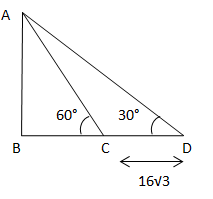
From the top of a lamp post, two objects on the ground on the same side of it (and in line with the foot of the lamp post)are observed at angles of depression of 30° and 60°, respectively. The distance between the objects is-

Answer & explanation+

Correct answer: option 2

tan Θ = \(\frac{AB}{base}\) ⇒ since AB is same for both

Ratio of tan Θ ∝ \(\frac{1}{Ratio\;of\;base}\)

Ratio of tan Θ         tan 60°     :       tan 30°

                              \(\sqrt {3}\)            :        \(\frac{1}{\sqrt {3}}\)
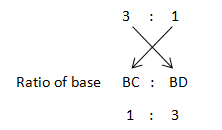
We know BD - BC = 16 \(\sqrt {3}\) m

⇒ 2R = 16 \(\sqrt {3}\) m

⇒ R = 8 \(\sqrt {3}\) m

In ΔABC;

tan 60° = \(\frac{AB}{8\sqrt {3}}\) ⇒ AB = 8 \(\sqrt {3}\) × \(\sqrt {3}\) = 24 m

Advertisement

Practise more on Quantitative Reasoning

Chapter-wise mocks on the real NTA exam screen, with solutions and your rank. Your first mocks are free.

Start free mocks →

Advertisement

Next questions

  1. Identify the correct suitable options for the given image.(A) This is an etching technique on paper(B) This is an intaglio technique(C) It…Fine Arts · The Modern Indian Art
  2. A motor car covered a certain distance in 9 hours, the first half distance at 12 km/h and the second half distance at 15 km/h. Find the tot…General Aptitude Test · Numerical Ability
  3. Shown in the figure is a vertically erect object placed on the optic axis at a distance (5/2)f from a concave mirror of focal length f. If…Physics · Ray Optics
  4. Arrange in correct sequence. (A) Receipt of application money(B) Amount due on allotment and received(C) Reissue of shares (already forfeit…Accountancy Part A · Accounting for Shares
  5. The main source of revenue for 'not for profit organisation' is:Accountancy Part A · Accounts for Non Profit Organsiation
  6. With respect to occupation, secondary activities include _______.General Aptitude Test · General Knowledge
  7. The brain capacity of Homo habilis was around ______ cc.Biology · Evolution
  8. Which among the following is a infectious stage of plasmodium that enters the human body ?Biology · Human Health and Disease
  9. A brick kiln needs extra unskilled workers.Plan P: put up a notice on its notice-board and pick workers on the spot on the given date.Plan…Business Studies · Staffing
  10. Why do organisms evolve specific reproductive strategies?Biology · Organisms and Populations