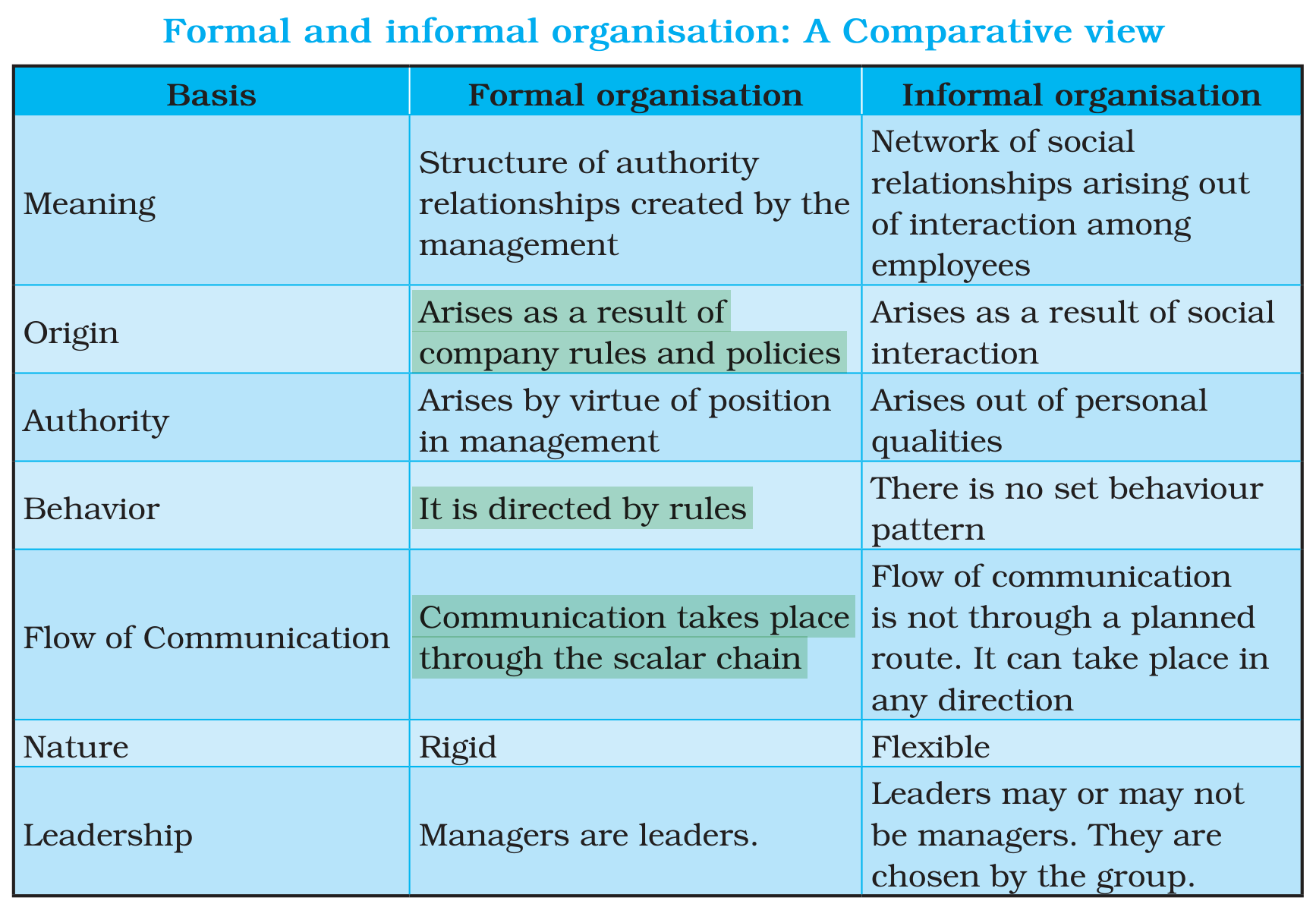
Which of the following are the characteristics of Formal Organization?
(A) It is directed by rules.
(B) Communication takes place through the scalar chain
(C) Arises as a result of company rules and policies
(D) Leaders may or may not be managers. They are chosen by the group.
Choose the correct answer from the options given below:
Answer & explanation
Correct answer: option 2
The correct answer is Option (2) → (A), (B) and (C) only
A formal organisation is the structure designed by the management to do a given task. It fixes the limits of authority and responsibility.
(A) It is directed by rules. — A characteristic of formal organisation (Correct). Its behaviour follows the rules and procedures laid down by the management.
(B) Communication takes place through the scalar chain — A characteristic of formal organisation (Correct). Messages follow the official line of authority from superior to subordinate.
(C) Arises as a result of company rules and policies — A characteristic of formal organisation (Correct). It is created on purpose by the management through its rules and policies.
(D) Leaders may or may not be managers. They are chosen by the group. — Not a characteristic of formal organisation (Incorrect). This is true of the informal organisation, which grows out of social contact among employees. In the formal organisation, the managers are the leaders.
NCERT (2026-27 Edition): “Formal and Informal Organisation … Formal organisation refers to the organisation structure which is designed by the management to accomplish a particular task. …” “(b) It is a means to achieve the objectives specified in the plans, as it lays down rules and procedures essential for their achievement.”
|