
Minimise $Z=-50x+20y$
subject to the constraints: $2x-y≥-5, 3x+y≥3, 2x-3y ≤ 12, x ≥0, y ≥0$.
Then which of the following is/are true:
(A) Feasible region is unbounded.
(B) Z has no minimum value.
(C) The minimum value of Z is 100.
(D) The minimum value of Z is -300.
Choose the correct answer from the options given below:
Answer & explanation
Correct answer: option 1
The correct answer is Option (1) → (A) and (B) only
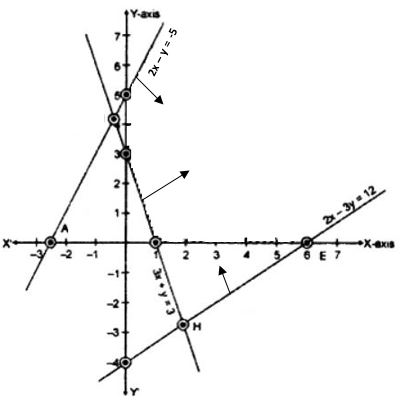
Rewriting the constraints:
$y \le 2x + 5, \quad y \ge 3 - 3x, \quad y \ge \frac{2x - 12}{3}, \quad x \ge 0, \ y \ge 0.$
Thus, the feasible region lies above $y = 3 - 3x$ and $y = \frac{2x - 12}{3}$, and below $y = 2x + 5$, in the first quadrant. From the graph, the region extends indefinitely towards the right; hence, it is unbounded.
(A) The feasible region is unbounded — True
The region is not enclosed from all sides and keeps extending for larger values of $x$. Hence, it is unbounded.
(B) $Z$ has no minimum value — True
Along the boundary $y = \frac{2x - 12}{3}$,
$Z = \frac{-110x - 240}{3}.$
As $x$ increases, $Z$ keeps decreasing without limit. Therefore, no minimum value is attained.
(C) $Z$ has a maximum value — False
Since the region is unbounded, we must check if $Z$ can increase indefinitely. However, the constraints restrict the increase in $y$ relative to $x$, and evaluating corner points shows that a highest value of $Z$ is attained at a vertex. Hence, maximum exists, so this statement (if claiming no maximum or otherwise incorrect) is false.
(D) The feasible region is bounded — False
This contradicts the graph, as the region clearly extends infinitely in one direction.
∴ feasible region is unbounded.
∴ Z has no minimum value.
Note: This question was dropped by NTA as none of the given options was correct. To ensure that students still benefit from practicing this concept, one of the options has been suitably modified so that the question now has a correct answer.