
Solubility of a gas in a liquid:
Answer & explanation
Correct answer: option 1
The correct answer is Option (1) → Decreases with rise in temperature
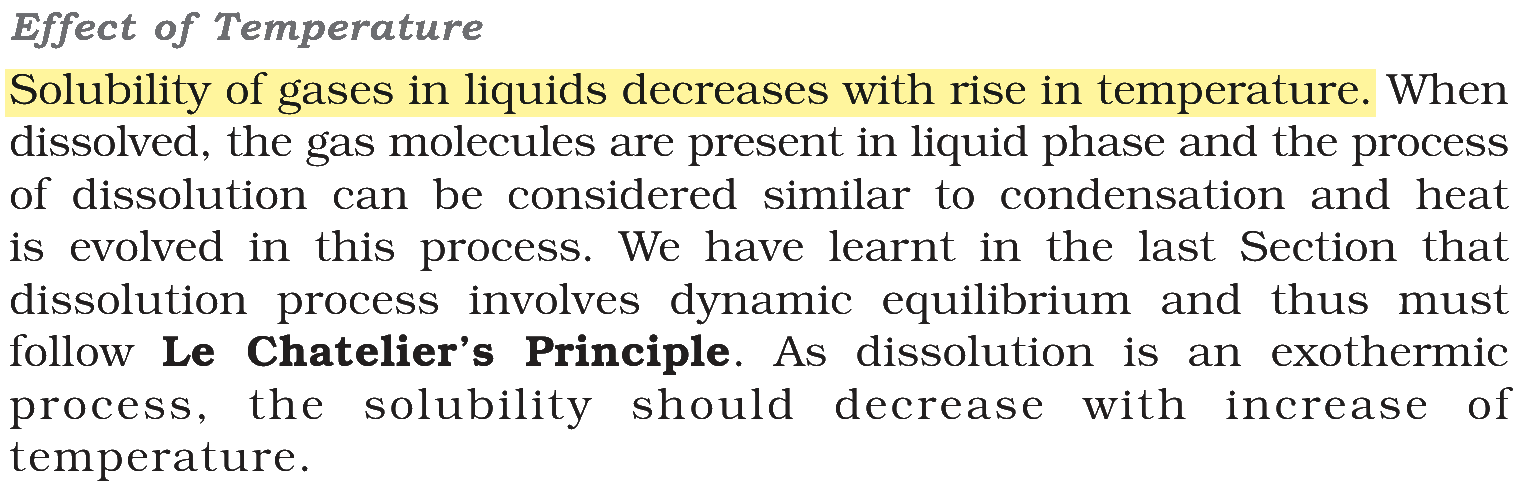
When a gas dissolves, its molecules pass into the liquid phase. Dissolution of a gas is exothermic. The dissolved gas is in dynamic equilibrium with the gas above the liquid:
\( \displaystyle \text{gas} + \text{solvent} \ce{<=>} \text{solution} \qquad \Delta H \lt 0 \)
So on heating, gas comes out of solution (Le Chatelier’s principle). That is why bubbles appear when water is warmed, and why fish find less oxygen in warm water. The Henry’s law constants of gases such as \( \ce{N2} \) and \( \ce{O2} \) increase with temperature, which also means lower solubility.
So the solubility of a gas in a liquid decreases with rise in temperature.
Why the other options are incorrect
Option (2) Increases with rise in temperature — Incorrect. This is the usual behaviour of many solids in water, whose dissolution absorbs heat; gases dissolve with release of heat, so the trend is the opposite.
Option (3) Does not depend on temperature — Incorrect. The value of \( K_H \) changes with temperature, so the solubility at a given pressure changes too.
Option (4) First decreases and then increases with rise in the temperature — Incorrect. The dissolution stays exothermic, so the solubility keeps falling as the temperature rises; there is no reversal.
NCERT (2026-27 edition):
Effect of Temperature
Note: The same/similar question has been asked in different years by NTA as per the details given below:
| 2026 | 2025 | 2024 | 2023 | 2022 |
|---|---|---|---|---|
| – | 24-05 S2 | – | 21-05 S3 | – |