Match list I with list II.
| LIST 1 |
LIST II |
| A. Treasury Bill | I. Mobilise large amount of money |
| B. Commercial paper | II. Maturity period of one day to fifteen days |
| C. Call money | III. Maturity period of 15 days to one year |
| D. Certificate of deposits | IV. Issued by RBI |
Choose the correct answer from the options given below:
Answer & explanation
Correct answer: option 3
The correct answer is Option (3) → A-IV, B-III, C-II, D-I
A. Treasury Bill — matches IV. Issued by RBI. A treasury bill is a short-term loan taken by the Government of India. It is issued by the Reserve Bank of India on behalf of the Central Government.
B. Commercial paper — matches III. Maturity period of 15 days to one year. Large and creditworthy companies issue it to raise short-term funds. It usually has a maturity period of 15 days to one year.
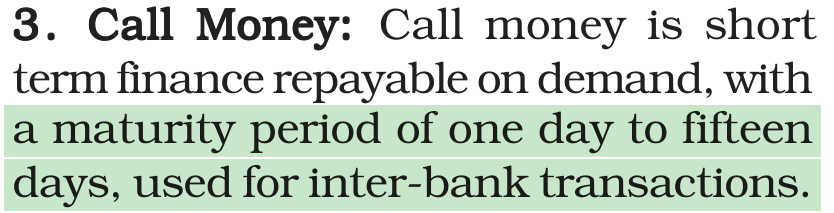
C. Call money — matches II. Maturity period of one day to fifteen days. Banks lend call money to each other for a very short time. It has a maturity period of one day to fifteen days.
D. Certificate of deposits — matches I. Mobilise large amount of money. Banks issue certificates of deposit when they need funds. They help to mobilise (collect) a large amount of money for short periods.
Note: Although the chapter ‘Financial Markets’ was dropped from the NCERT textbooks during rationalisation, it has stayed in the NTA syllabus every year since 2022, except for 2025, and it is part of the syllabus again from 2026. This question is therefore based on the pre-rationalised NCERT, an extract from which is given below. NCERT (Pre-rationalised Edition): “1. Treasury Bill: … They are also known as Zero Coupon Bonds issued by the Reserve Bank of India on behalf of the Central Government to meet its short-term requirement of funds. …” “2. Commercial Paper: … It is issued by large and creditworthy companies to raise short-term funds at lower rates of interest than market rates. It usually has a maturity period of 15 days to one year. …” “4. Certificate of Deposit: … They can be issued to individuals, corporations and companies during periods of tight liquidity when the deposit growth of banks is slow but the demand for credit is high. They help to mobilise a large amount of money for short periods.”
|