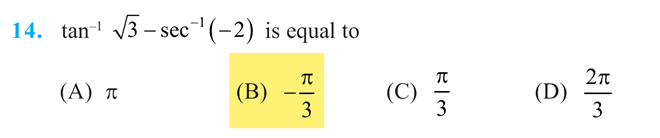
The value of \( \tan^{-1}(\sqrt{3})-\sec^{-1}(-2) \) is
Answer & explanation
Correct answer: option 3
The correct answer is Option (3) → \( -\displaystyle\frac{\pi}{3} \)
The principal value branches are \( \tan^{-1}:\left(-\frac{\pi}{2},\frac{\pi}{2}\right) \) and \( \sec^{-1}:[0,\pi]-\left\{\frac{\pi}{2}\right\} \).
\( \displaystyle \tan^{-1}(\sqrt{3})=\frac{\pi}{3} \)
\( \displaystyle \sec^{-1}(-2)=\pi-\sec^{-1}(2) \)
\( \displaystyle =\pi-\frac{\pi}{3}=\frac{2\pi}{3} \)
\( \displaystyle \tan^{-1}(\sqrt{3})-\sec^{-1}(-2)=\frac{\pi}{3}-\frac{2\pi}{3} \)
\( \displaystyle =-\frac{\pi}{3} \)
Why the other options are incorrect
Option (1) \( \displaystyle\frac{\pi}{3} \) — Incorrect. \( \frac{\pi}{3} \) is only the value of \( \tan^{-1}(\sqrt{3}) \); the second term \( \frac{2\pi}{3} \) still has to be subtracted.
Option (2) 0 — Incorrect. 0 comes from taking \( \sec^{-1}(-2)=\frac{\pi}{3} \), ignoring the negative sign.
Option (4) \( \displaystyle\frac{2\pi}{3} \) — Incorrect. \( \frac{2\pi}{3} \) comes from taking \( \sec^{-1}(-2)=-\frac{\pi}{3} \), which lies outside the principal branch [0, π].
Tip: For negative arguments use \( \sec^{-1}(-x)=\pi-\sec^{-1}x \) (like \( \cos^{-1} \)), not \( -\sec^{-1}x \) (which applies to \( \tan^{-1} \) and \( \sin^{-1} \)).
NCERT (2026-27 edition):
Basic Concepts