
Identify the reagent used in the following reaction:
Answer & explanation
Correct answer: option 4
The correct answer is Option (4) → \(CHCl_3 + aq.NaOH\)
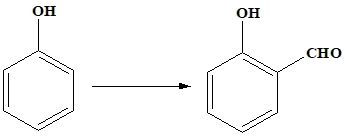
The conversion of phenol into salicylaldehyde (2-hydroxybenzaldehyde) introduces a –CHO group at the ortho position. This is the Reimer-Tiemann reaction: phenol is treated with chloroform and aqueous sodium hydroxide. The phenoxide ion is attacked at the ortho position by dichlorocarbene (from \( \ce{CHCl3} \) + \( \ce{OH^{-}} \)); the substituted benzal chloride formed is hydrolysed by the alkali, and acidification gives salicylaldehyde.
\( \ce{C6H5OH} \) + \( \ce{CHCl3} \) + aq. NaOH (340 K) → substituted benzal chloride (intermediate) → (NaOH, then \( \ce{H+} \)) o-\( \ce{HOC6H4CHO} \) (salicylaldehyde)
Why the other options are incorrect
Option (1) \(CCl_4 + aq.NaOH\) — Incorrect. With carbon tetrachloride the ortho group introduced is –\( \ce{CCl3} \), which hydrolyses to –COOH, giving salicylic acid, not salicylaldehyde.
Option (2) \(CCl_4 + alc.KOH\) — Incorrect. Alcoholic KOH does not bring about the Reimer-Tiemann reaction, and \( \ce{CCl4} \) would in any case lead to the acid, not the aldehyde.
Option (3) \(CHCl_3 + CS_2\) — Incorrect. No base is present, so neither the phenoxide ion nor dichlorocarbene can form; \( \ce{CS2} \) is only a solvent.
NCERT (2026-27 edition):
Reimer-Tiemann Reaction – “On treating phenol with chloroform in the presence of sodium hydroxide, a –CHO group is introduced at ortho position of benzene ring. This reaction is known as Reimer - Tiemann reaction. The intermediate substituted benzal chloride is hydrolysed in the presence of alkali to produce salicylaldehyde.”