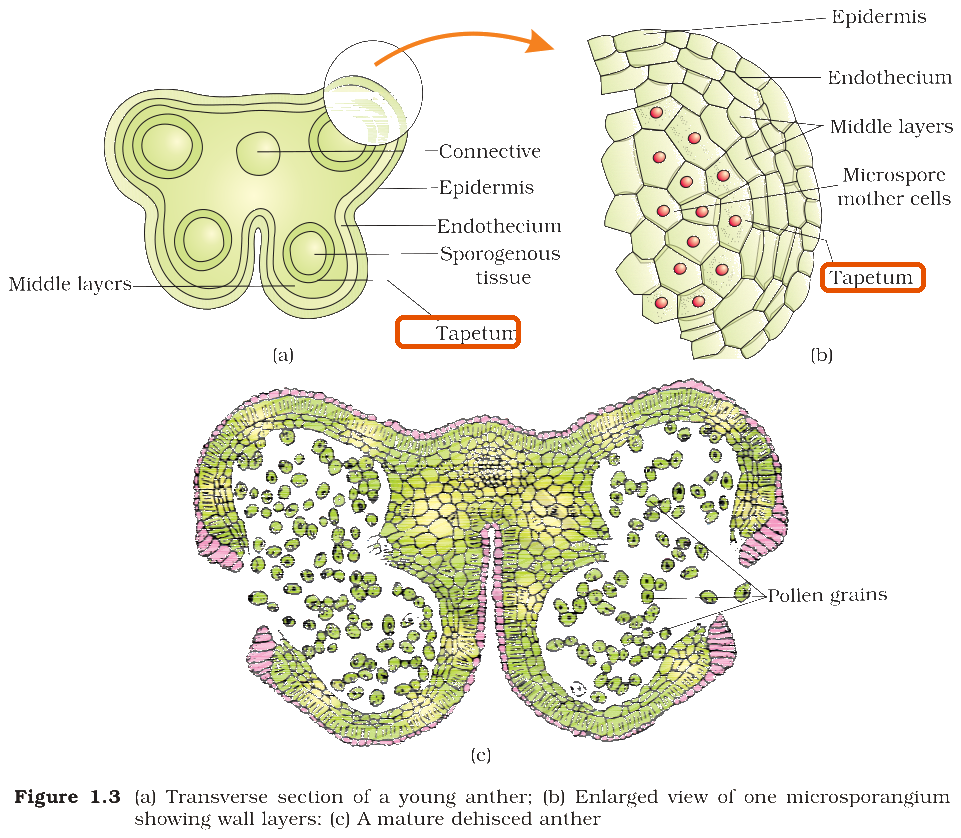
In a typical microsporangium, the function of tapetum is -
Answer & explanation
Correct answer: option 3
The correct answer is Option (3) → Nourishment to developing pollen grains
The anther wall has four layers: epidermis, endothecium, middle layers and tapetum. The tapetum is the innermost layer, lying next to the sporogenous tissue, and it nourishes the developing pollen grains.
Option (1) Nourishment to developing ovules — Incorrect. Ovules lie in the ovary, not in the anther.
Option (2) Nourishment to developing stigma — Incorrect. The stigma is part of the pistil, the female part of the flower. The tapetum lies inside the anther, so it feeds only the cells growing there.
Option (3) Nourishment to developing pollen grains — Correct. The innermost wall layer of the microsporangium is the tapetum. Its cells have dense cytoplasm and generally more than one nucleus, and it nourishes the developing pollen grains.
Option (4) Nourishment to developing thalamus — Incorrect. The thalamus is the base of the flower that bears all its parts.
NCERT Extract:
Stamen, Microsporangium and Pollen Grain – “… Structure of microsporangium: In a transverse section, a typical microsporangium appears near circular in outline. It is generally surrounded by four wall layers (Figure 1.3b)– the epidermis, endothecium, middle layers and the tapetum. The outer three wall layers perform the function of protection and help in dehiscence of anther to release the pollen. The innermost wall layer is the tapetum. It nourishes the developing pollen grains.”