
Which of the following compounds will show the least reactivity towards nucleophilic addition reaction?
Answer & explanation
Correct answer: option 2
The correct answer is Option (2) → Acetophenone
Reactivity towards nucleophilic addition depends on how positive (electrophilic) the carbonyl carbon is and how crowded it is. Aldehydes are more reactive than ketones: a ketone has two groups that hinder the approach of the nucleophile and reduce the positive charge on the carbonyl carbon. Among aromatic aldehydes, an electron-withdrawing group on the ring raises the reactivity and an electron-donating group lowers it.
Acetophenone, \( \ce{C6H5COCH3} \), is a ketone: it has both a methyl group (+I effect) and a phenyl ring whose resonance reduces the positive charge on the carbonyl carbon, and two groups crowd that carbon. So it is the least reactive. The order is:
\( \displaystyle p\text{-nitrobenzaldehyde} \gt \text{benzaldehyde} \gt p\text{-methylbenzaldehyde} \gt \text{acetophenone} \)
Why the other options are incorrect
Option (1) Benzaldehyde — Incorrect. It is an aldehyde, with only one group next to the carbonyl carbon, so it is more reactive than a ketone.
Option (3) p-Methylbenzaldehyde — Incorrect. The methyl group donates electrons and lowers the reactivity a little, but it is still an aldehyde and more reactive than acetophenone.
Option (4) p-Nitrobenzaldehyde — Incorrect. The nitro group withdraws electrons and makes the carbonyl carbon more positive, so it is the most reactive of the four.
NCERT (2026-27 edition):
Reactivity
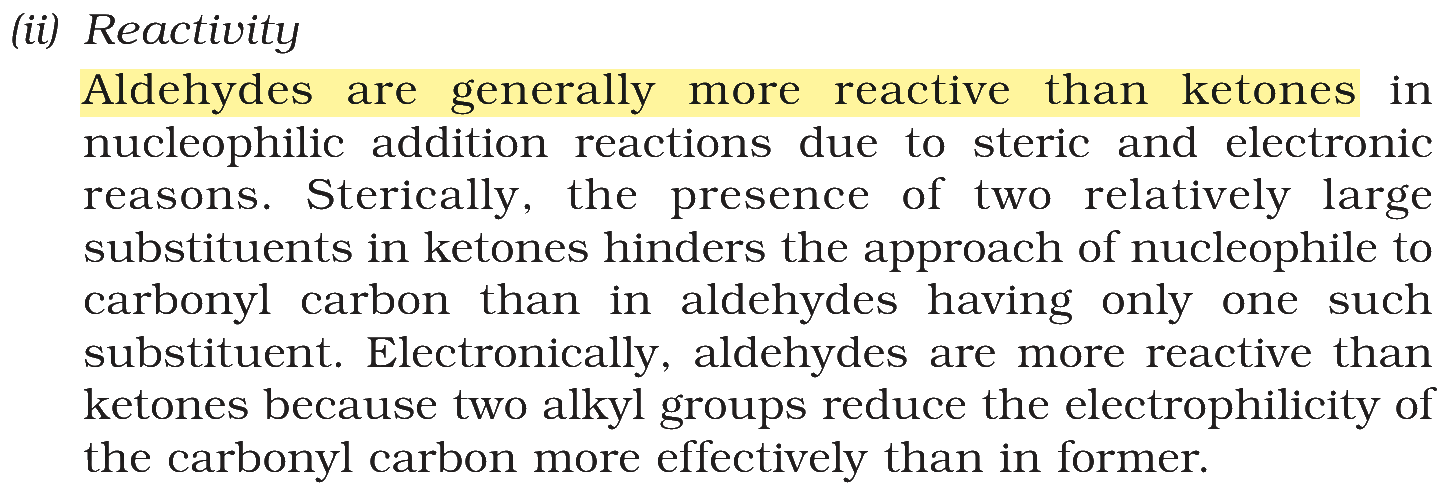
“… The carbon atom of the carbonyl group of benzaldehyde is less electrophilic than carbon atom of the carbonyl group present in propanal. The polarity of the carbonyl group is reduced in benzaldehyde due to resonance … and hence it is less reactive than propanal.”