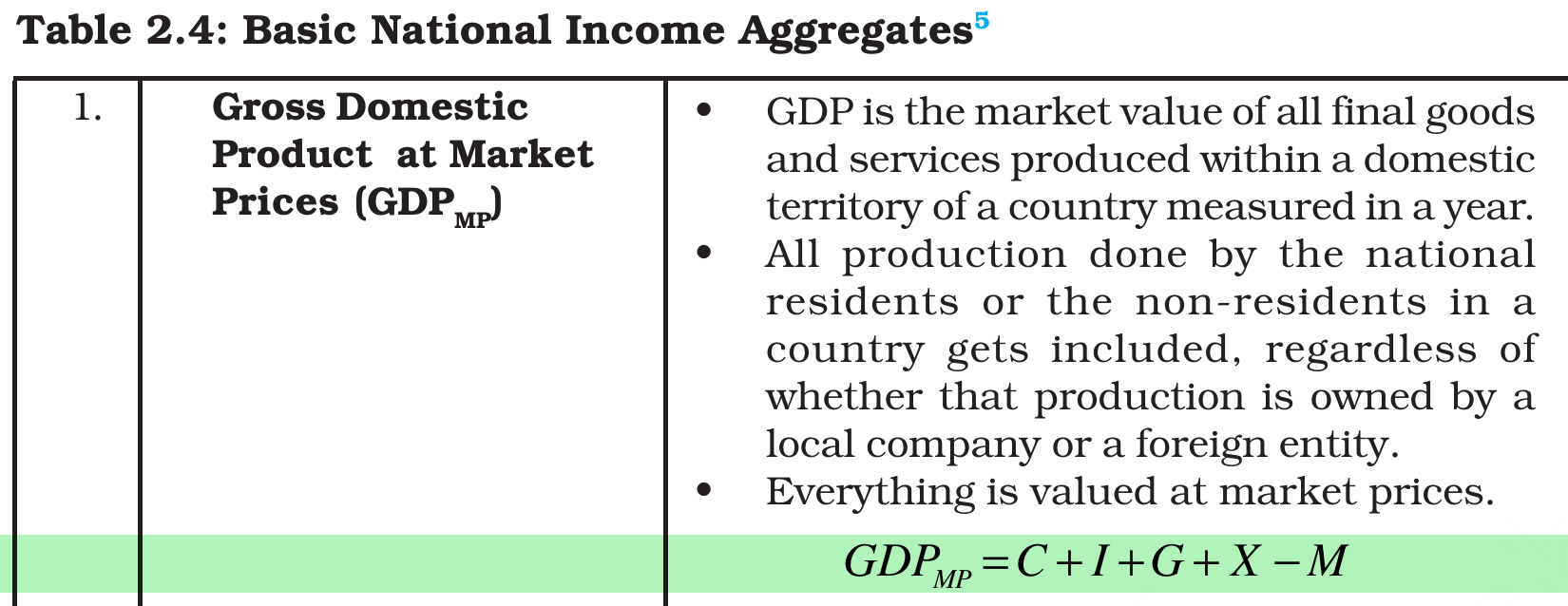
Match List-I with List-II
| List-I | List-II |
| (A) Gross Domestic Product at Market Price | (I) NDPMP - Net Product Taxes - Net Production Taxes |
| (B) Net Domestic Product at Factor Cost | (II) GVA at basic prices - Net Production Taxes |
| (C) GVA(Gross Value Added) at factor cost | (III) \( C+I+G+(X-M) \) |
| (D) Gross National Product at Factor Cost | (IV) GNPMP - Net Product Taxes - Net Production Taxes |
Choose the correct answer from the options given below:
Answer & explanation
Correct answer: option 2
The correct answer is Option (2) → (A)-(III), (B)-(I), (C)-(II), (D)-(IV)
National income aggregates are linked by a few conversions: gross to net (less depreciation), domestic to national (plus net factor income from abroad), and market price to factor cost (less net product taxes and net production taxes). Each item of List-I is reached by one of these.
(A) Gross Domestic Product at Market Price — this matches (III) \( C+I+G+(X-M) \). By the expenditure method, GDP at market prices is the total final expenditure on domestic output: consumption, investment, government purchases and net exports.
(B) Net Domestic Product at Factor Cost — this matches (I) NDPMP − Net Product Taxes − Net Production Taxes. Removing all net indirect taxes from NDP at market prices leaves the incomes earned by the factors within the country.
(C) GVA(Gross Value Added) at factor cost — this matches (II) GVA at basic prices − Net Production Taxes. GVA at basic prices already excludes product taxes; taking away the net production taxes as well gives GVA at factor cost.
(D) Gross National Product at Factor Cost — this matches (IV) GNPMP − Net Product Taxes − Net Production Taxes. The same conversion from market price to factor cost, applied to GNP instead of NDP.
NCERT (2026-27): Introductory Macroeconomics — Chapter 2: National Income Accounting, Table 2.4: Basic National Income Aggregates
|