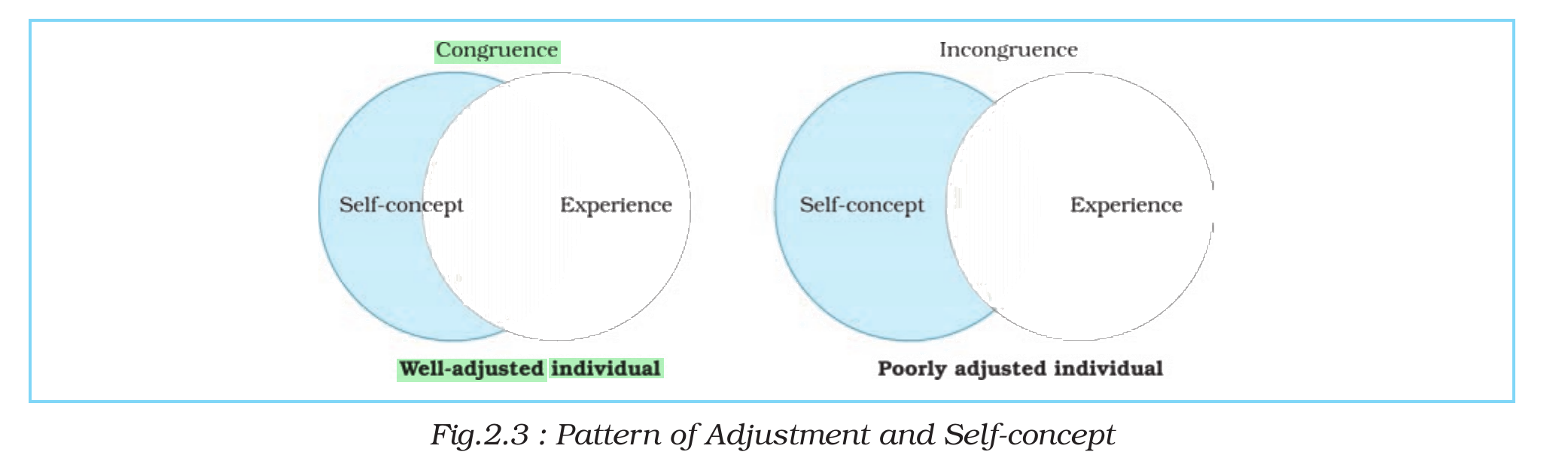
Which of the following pattern can be observed in a well-adjusted individual?
Answer & explanation
Correct answer: option 2
The correct answer is Option (2) → Congruence with self concept and experience
In Rogers’ humanistic theory, a person is well adjusted when her or his self-concept agrees with her or his experience. When the two overlap largely there is congruence; when they overlap little there is incongruence, and the person is poorly adjusted.
Option (1) Incongruence between self concept and experience — Incorrect. Incongruence, a gap between what a person thinks she or he is and what she or he experiences, marks a poorly adjusted individual.
Option (2) Congruence with self concept and experience — Correct. When self-concept and experience match, the person sees herself or himself as she or he really is, and is a well-adjusted individual. In the same way Rogers held that a person is generally happy when there is a correspondence between the real self and the ideal self.
Option (3) Incongruence between self-esteem and experience — Incorrect. Rogers’ pattern of adjustment compares self-concept with experience, not self-esteem; and incongruence of any kind points to poor adjustment.
Option (4) Incongruence between thoughts and ideas — Incorrect. Thoughts and ideas are not the two sides of Rogers’ pattern, and again incongruence would mean poor adjustment.
NCERT (2025-26): “Humanistic Approach … Rogers suggests that each person also has a concept of ideal self. An ideal self is the self that a person would like to be. When there is a correspondence between the real self and ideal self, a person is generally happy. Discrepancy between the real self and ideal self often results in unhappiness and dissatisfaction.…”
|