Read the passage given below to answer.
In our day-to day life, we assign certain causes or reasons to a person's behaviour. This process is called attribution. Broadly, causes of a person are attributed to internal and external factors. External factors are related to situation. With reference to success and failure, Weiner has classified causes into internal/external and stable/unstable factors. In general, people attribute success to internal factors such as their ability and hard work. However, failure is attributed to external factors such as task difficulty and bad luck. Ability/fate and hard-work/task-difficulty are considered as stable and unstable factors respectively. Stable factors refer to those causes that do not change with time. It has been observed that people have a tendency to give greater weightage to internal factors than external one. This phenomenon is called the fundamental attribution error. This tendency is stronger in some cultures than in others. Research suggests that Indians tend to make more external attributions than Americans do.
Match List - I with List - II.
| List - I (Characteristics) | List - II (Causal factors) | ||
| (A) | Task characteristics | (I) | Internal-stable |
| (B) | Hard work | (II) | External-stable |
| (C) | Fate | (III) | Unstable-Internal |
| (D) | Ability | (IV) | Unstable-External |
Choose the correct answer from the options given below :
Answer & explanation
Correct answer: option 4
The correct answer is Option (4) → (A) - (IV), (B) - (III), (C) - (II), (D) - (I)
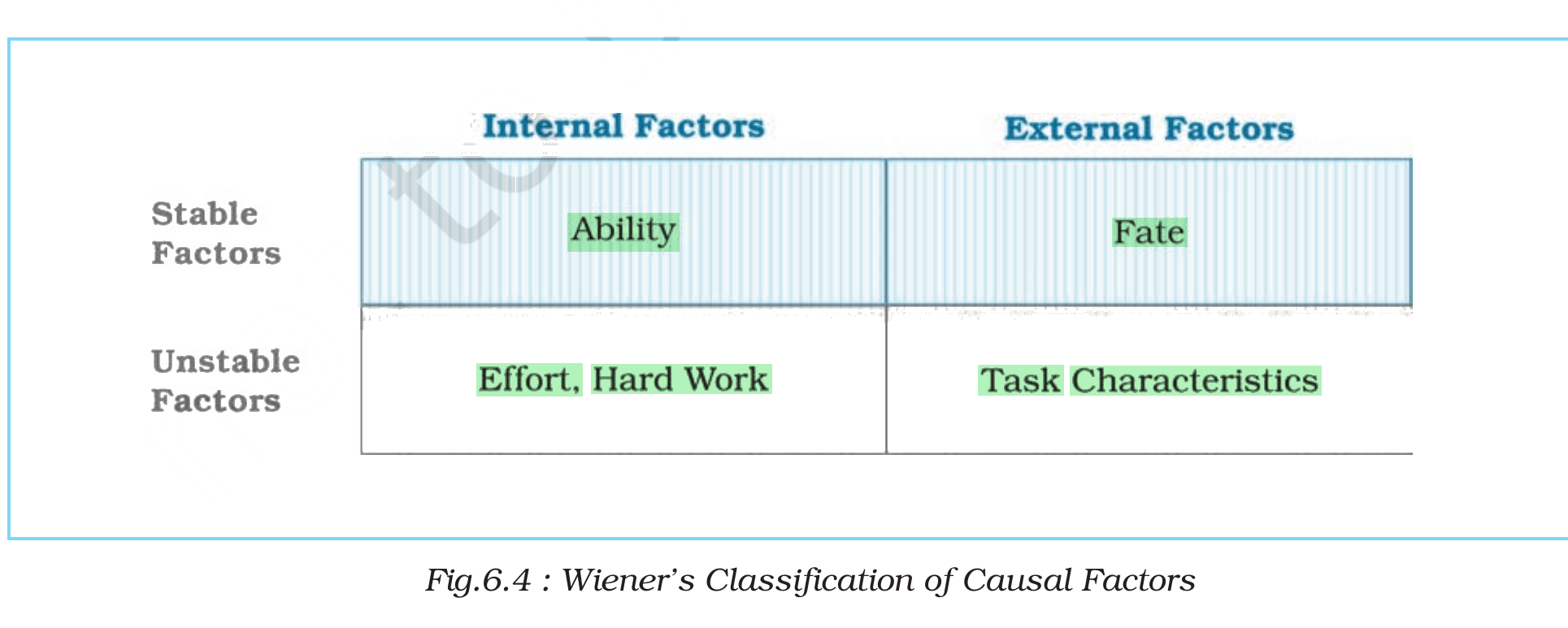
Weiner classified the causes of success and failure on two dimensions: internal or external (within the person or outside) and stable or unstable (causes that do not change with time, or those that do). Each characteristic of List-I takes one cell of this two-by-two classification.
(A) Task characteristics — this matches (IV) Unstable-External. The task lies outside the person, and it changes from one task to the next, so in Weiner’s figure it sits in the external, unstable cell.
(B) Hard work — this matches (III) Unstable-Internal. Effort comes from within the person, but a person can work hard for one examination and not for the next, so it is internal but unstable.
(C) Fate — this matches (II) External-stable. Fate is outside the person’s control and is seen as fixed, not changing with time.
(D) Ability — this matches (I) Internal-stable. Ability belongs to the person and stays much the same over time.
Note: Weiner’s classification of causal factors (Fig. 6.4) was given in the chapter ‘Attitude and Social Cognition’ of the pre-rationalised NCERT, which NTA followed in 2022, and is not there in the NCERT book (2025-26) or in the 2023-24 NCERT.
NCERT (Pre-rationalised): “Attribution of Causality … When people make attributions for success and failure, the causes they give can be classified into internal or external factors, and also into stable or unstable factors. Bernard Wiener suggested a classification which is shown in Figure 6.4. Stable factors refer to those causes that do not change with time, while unstable factors are those that do change.…”
|