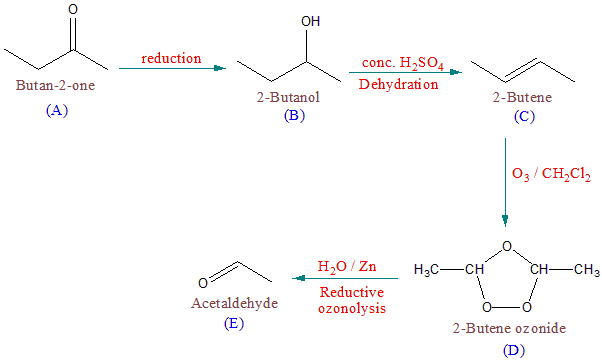
A carbonyl compound A(C4H8O), which undergoes haloform reaction gives compound B on reduction. B on heating with sulphuric acid gives a compound C which forms a mono-ozonide D. D on hydrolysis in present of zinc dust gives only acetaldehyde E.
While converting from B to C, H2SO4 is used as a catalyst. What is the role of H2SO4 in this reaction?
Answer & explanation
Correct answer: option 1
The correct answer is option 1. Dehydrating agent
Since carbonyl compound A(C4H8O) undergoes a haloform reaction, it must contain the group CH3CO. Therefore, it is a ketone and must be biutan-2-one.
Since ketone A, i.e., butan-2-one gives compound B on reduction, therefore B must be 2-butanol.
Since B, i.e., 2-Butanol on heating with H2SO4 gives compound C which forms a mono-ozonide, therefore compound C must be an alkene.
Since alkene C forms a mono-ozonide D which on hydrolysis in presence of zinc dust (i.e., reductive ozonolysis) gives only acetaldehyde E, therefore, C must be symmetrical alkene , i.e., 2-Butene.
All the reactions involved are: