Match List-I with List-II
List-I
(A) Goodwill already exist in the books
(B) New partner does not bring his share of goodwill
(C) New partner brings his share of goodwill and decided to retain goodwill in the business
(D) Goodwill is paid privately
List-II
(I) New Partner's Current A/c Dr.
To Sacrificing Partners' Capital A/c
(II) Old Partners' Capital A/c Dr.
To Goodwill A/c
(III) No Entry
(IV) Premium for Goodwill A/c Dr.
To Sacrificing Partners' Capital A/c
Choose the correct answer from the options given below:
Answer & explanation
Correct answer: option 3
The correct answer is Option (3) → (A) - (II), (B) - (I), (C) - (IV), (D) - (III)
On admission, the new partner pays the old partners for the goodwill they built up. How it is recorded depends on whether goodwill is already in the books and how the new partner pays for his share.
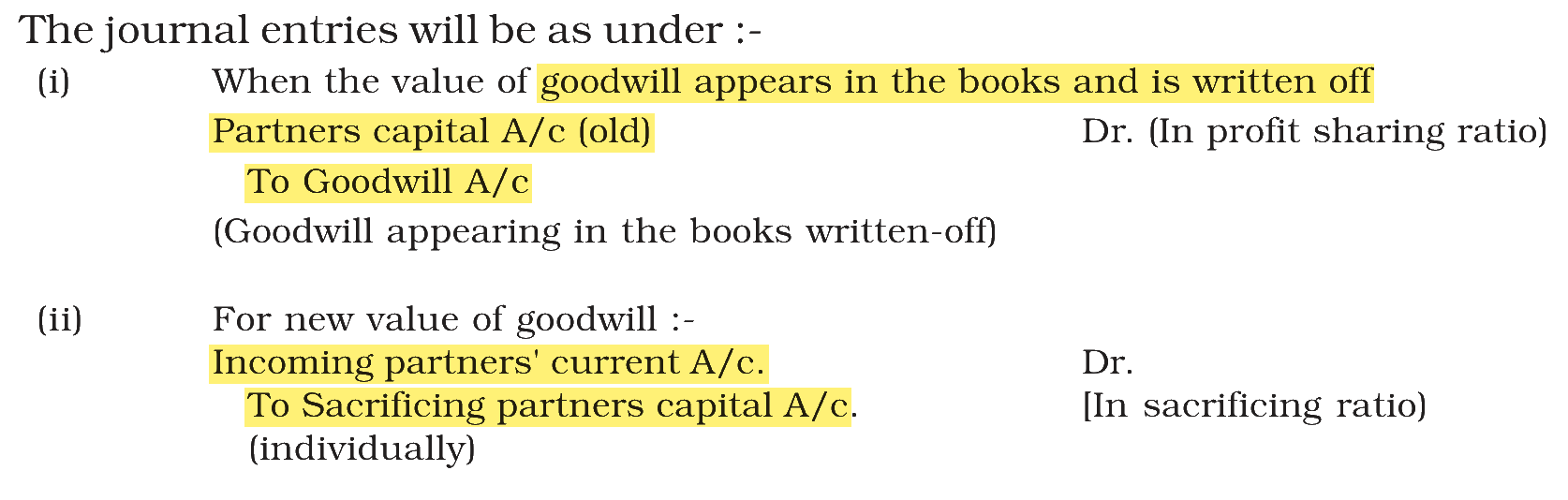
(A) Goodwill already exist in the books — this matches (II) Old Partners' Capital A/c Dr. To Goodwill A/c. Goodwill already in the books is written off among the old partners in their old ratio, so that the new partner does not get a share of it free.
(B) New partner does not bring his share of goodwill — this matches (I) New Partner's Current A/c Dr. To Sacrificing Partners' Capital A/c. His share is charged to his current account and credited to the old partners in their sacrificing ratio.
(C) New partner brings his share of goodwill and decided to retain goodwill in the business — this matches (IV) Premium for Goodwill A/c Dr. To Sacrificing Partners' Capital A/c. The premium brought in cash is shared by the old partners in their sacrificing ratio and kept in the business.
(D) Goodwill is paid privately — this matches (III) No Entry. The money passes directly between the partners and never comes into the firm, so nothing is recorded in its books.
NCERT (2026-27 edition):
|