The incorrect equation for Arrhenius equation for activation energy is :
Answer & explanation
Correct answer: option 2
The correct answer is Option (2) → \( \displaystyle \log k=-\frac{E_a}{2.303\,R}\,\frac{1}{T\times\log A} \)
The Arrhenius equation relates the rate constant to temperature, and every other form is obtained from it by taking logarithms:
\( \displaystyle k = A\,e^{-E_a/RT} \)
\( \displaystyle \ln k = \ln A - \frac{E_a}{RT} \)
\( \displaystyle \log k = \log A - \frac{E_a}{2.303\,RT} \)
Writing the last equation at T1 and T2 (A is the same) and subtracting gives the two-temperature form:
\( \displaystyle \log\frac{k_2}{k_1} = \frac{E_a}{2.303\,R}\left(\frac{T_2-T_1}{T_1T_2}\right) \)
In every correct form, log A (or ln A) is added to the Ea term. Option (2) puts log A in the denominator, multiplied by T, which does not follow from k = Ae−Ea/RT. So Option (2) is the incorrect equation.
Option (1) \( \displaystyle \ln k=\ln A-\frac{E_a}{RT}\ln e \) — A correct form. Since ln e = 1, this is ln k = ln A − Ea/RT.
Option (2) \( \displaystyle \log k=-\frac{E_a}{2.303\,R}\,\frac{1}{T\times\log A} \) — The incorrect equation. log A must be added to the Ea term, not placed in the denominator.
Option (3) \( \displaystyle \log\frac{k_2}{k_1}=\frac{E_a}{2.303\,R}\left(\frac{T_2-T_1}{T_1T_2}\right) \) — A correct form. This is the two-temperature form derived above.
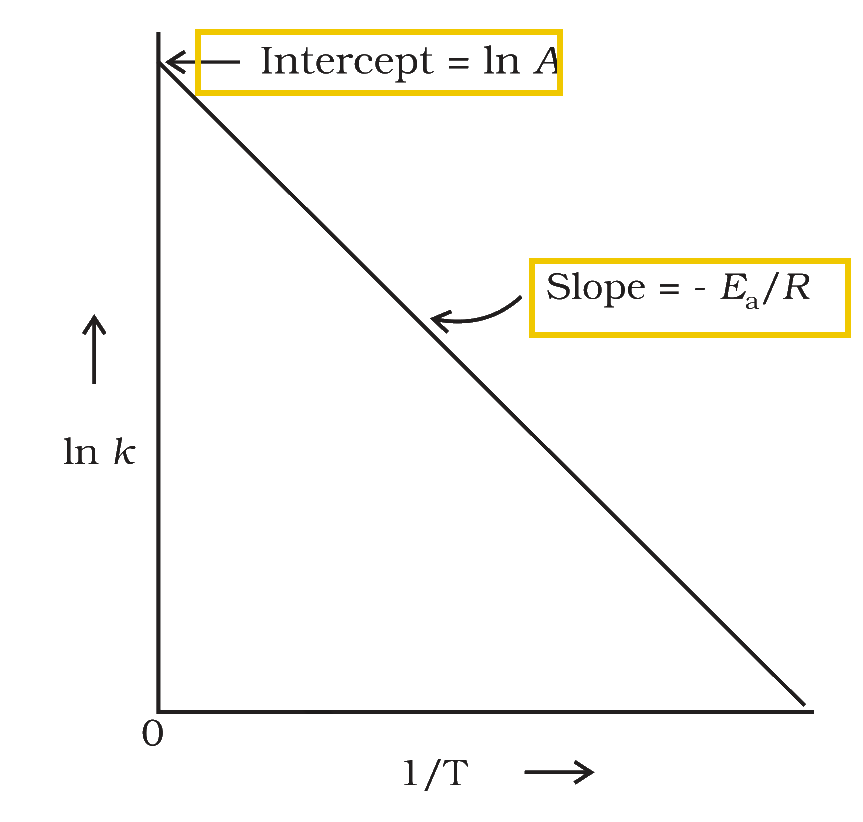
Option (4) \( \displaystyle \log k=-\frac{E_a}{2.303\,R}\times\frac{1}{T}+\log A \) — A correct form. This is the base-10 form, the straight line of log k against 1/T.
NCERT (2026-27 edition):
Temperature Dependence of the Rate of a Reaction – “… Taking natural logarithm of both sides of equation (3.18)
\( \displaystyle \ln k = -\frac{E_a}{RT} + \ln A \) (3.19)
The plot of ln k vs 1/T gives a straight line according to the equation (3.19) as shown in Fig. 3.10. Thus, it has been found from Arrhenius equation (3.18) that increasing the temperature or decreasing the activation energy will result in an increase in the rate of the reaction and an exponential increase in the rate constant.
In Fig. 3.10, slope = −Ea/R and intercept = ln A. So we can calculate Ea and A using these values.”