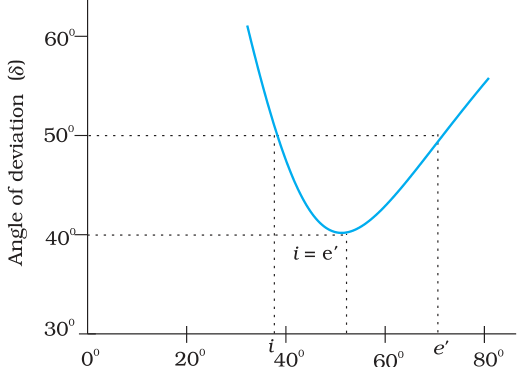
The graph between angle of deviation 'δ' and angle of incidence (i) for triangular prism is represented by:
Answer & explanation
Correct answer: option 3
The correct answer is Option (3)

For a ray passing through a prism of angle A, the total angle of deviation is \( \delta = i + e - A \), where i is the angle of incidence and e the angle of emergence. For a small i the ray emerges at a large e, and for a large i it emerges at a small e, so \( \delta \) is large at both ends. The two ends are joined through a single smallest value, the minimum deviation \( D_m \), reached when \( i = e \). So as i increases, \( \delta \) first falls to a minimum and then rises, a smooth curve shaped like a U.
NCERT (2026-27):
Refraction Through a Prism – “… Thus, the angle of deviation depends on the angle of incidence. A plot between the angle of deviation and angle of incidence is shown in Fig. 9.22. You can see that, in general, any given value of \( \delta \), except for \( i = e \), corresponds to two values \( i \) and hence of \( e \).”
Refraction Through a Prism – “… At the minimum deviation \( D_m \), the refracted ray inside the prism becomes parallel to its base.”