
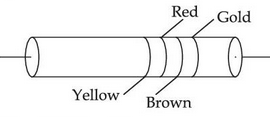
The carbon resistor has a set of coaxial coloured rings on it which are labelled here in the figure. What is the resistance value with a tolerance value for the colour coded resistor shown in the figure.
Answer & explanation
Correct answer: option 4
The correct answer is Option (4) → 420 Ω ± 5%
Read the colour code of the resistor from the end that carries the first band: the first two bands give two significant figures, the third band the decimal multiplier, and the last band the tolerance.
1st band, yellow → 4
2nd band, red → 2
3rd band, brown → multiplier \( 10^{1} \)
4th band, gold → tolerance \( \pm5\% \)
\( R = 42\times10^{1}\,\Omega = 420\,\Omega\ \pm5\% \)
Note: This question is from the pre-rationalised NCERT book (2022-23). The topic was removed from the latest NCERT book (2026-27), and it also appears to be out of the CUET 2026 syllabus.
NCERT (Pre-rationalised edition, 2022-23):
Resistivity of Various Materials – “… The resistors have a set of co-axial coloured rings on them whose significance are listed in Table 3.2. The first two bands from the end indicate the first two significant figures of the resistance in ohms. The third band indicates the decimal multiplier (as listed in Table 3.2). The last band stands for tolerance or possible variation in percentage about the indicated values.”
| Resistor colour codes | |||
|---|---|---|---|
| Colour | Number | Multiplier | Tolerance (%) |
| Black | 0 | 1 | |
| Brown | 1 | \( 10^{1} \) | |
| Red | 2 | \( 10^{2} \) | |
| Orange | 3 | \( 10^{3} \) | |
| Yellow | 4 | \( 10^{4} \) | |
| Green | 5 | \( 10^{5} \) | |
| Blue | 6 | \( 10^{6} \) | |
| Violet | 7 | \( 10^{7} \) | |
| Gray | 8 | \( 10^{8} \) | |
| White | 9 | \( 10^{9} \) | |
| Gold | \( 10^{-1} \) | 5 | |
| Silver | \( 10^{-2} \) | 10 | |
| No colour | 20 | ||