Match List - I with List - II.
| LIST-I | LIST-II | ||
| (A) | Population Momentum | (I) | Voluntary action to reduce population growth |
| (B) | Demographic Dividend | (II) | Large cohort of women at reproduction age |
| (C) | Population Pyramid | (III) | Group data in terms of gender and age |
| (D) | Preventive Check | (IV) | Higher proportion of workers compared to non-workers |
Choose the correct answer from the options given below:
Answer & explanation
Correct answer: option 2
The correct answer is Option (2) → (A)-(II), (B)-(IV), (C)-(III), (D)-(I)
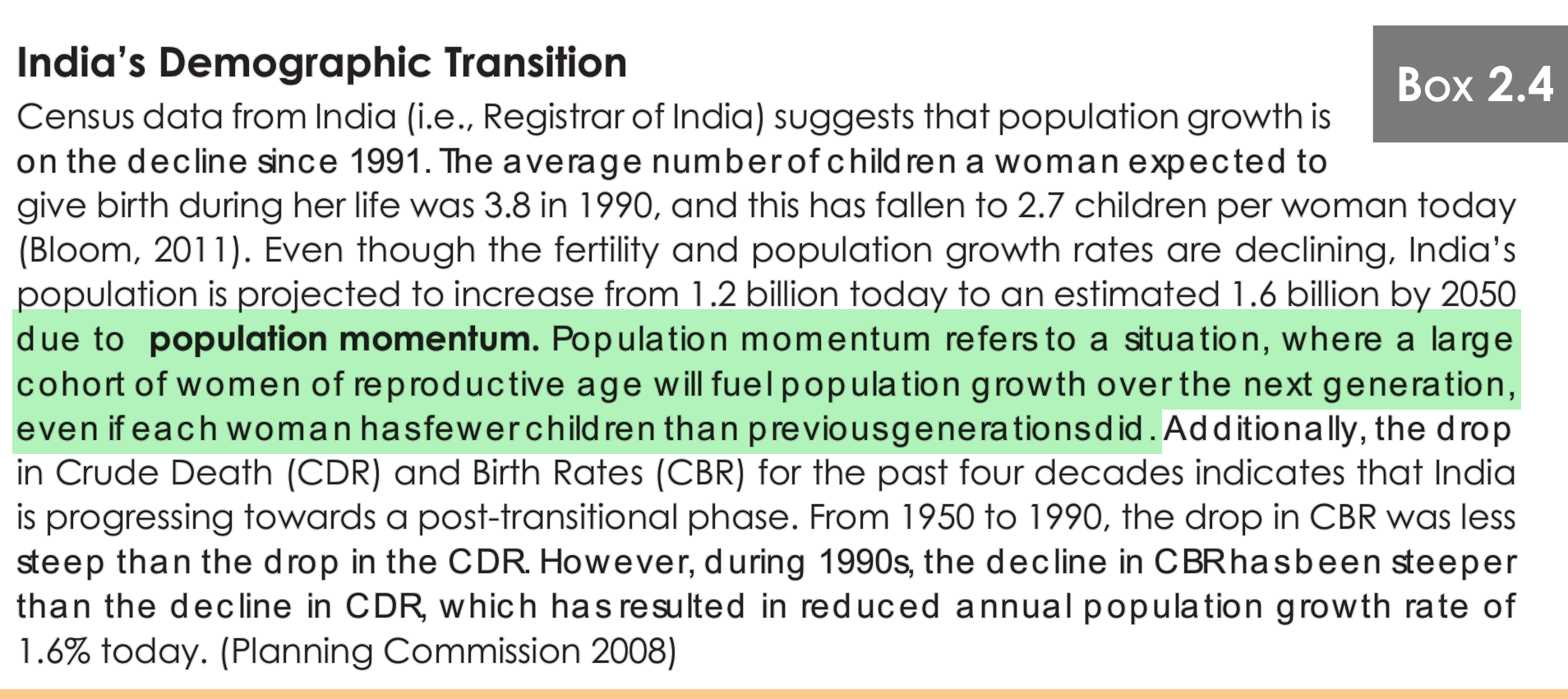
(A) Population Momentum — this matches (II) Large cohort of women at reproduction age. Population momentum is a situation where a large cohort of women of reproductive age will fuel population growth over the next generation, even if each woman has fewer children than earlier generations did.
(B) Demographic Dividend — this matches (IV) Higher proportion of workers compared to non-workers. A falling dependency ratio can be a source of economic growth because of the larger proportion of workers relative to non-workers; this benefit from the changing age structure is the demographic dividend.
(C) Population Pyramid — this matches (III) Group data in terms of gender and age. A population pyramid is a graphical picture of the age structure of a population, with bars for each age group, usually split into males and females.
(D) Preventive Check — this matches (I) Voluntary action to reduce population growth. For Malthus, preventive checks are the ways in which humanity can voluntarily reduce the growth of its population, such as postponing marriage or practising sexual abstinence or celibacy.
NCERT (2025-26): “2.1 Some Theories and Concepts in Demography … On the other hand, a falling dependency ratio can be a source of economic growth and prosperity due to the larger proportion of workers relative to non-workers. This is sometimes refered to as the ‘demographic dividend’, or benefit flowing from the changing age structure. However, this benefit is temporary because the larger pool of working age people will eventually turn into non-working old people.” “2.1 Some Theories and Concepts in Demography … Unfortunately, humanity has only a limited ability to voluntarily reduce the growth of its population (through ‘preventive checks’ such as postponing marriage or practicing sexual abstinence or celibacy).…” “2.3 Age Structure of the Indian Population … Chart 3 shows a graphical picture of the ‘population pyramid’ from 1961 to its projected shape in 2026.”
Box 2.4: India’s Demographic Transition |