Select the correct relation between the electrochemical cell and Gibbs free energy for the following reaction
\( Zn(s) + Cu^{2+}(aq) → Zn^{2+}(aq) + Cu(s) \)
Answer & explanation
Correct answer: option 2
The correct answer is Option (2) → \(Δ_rG=-2FE_{cell}\)
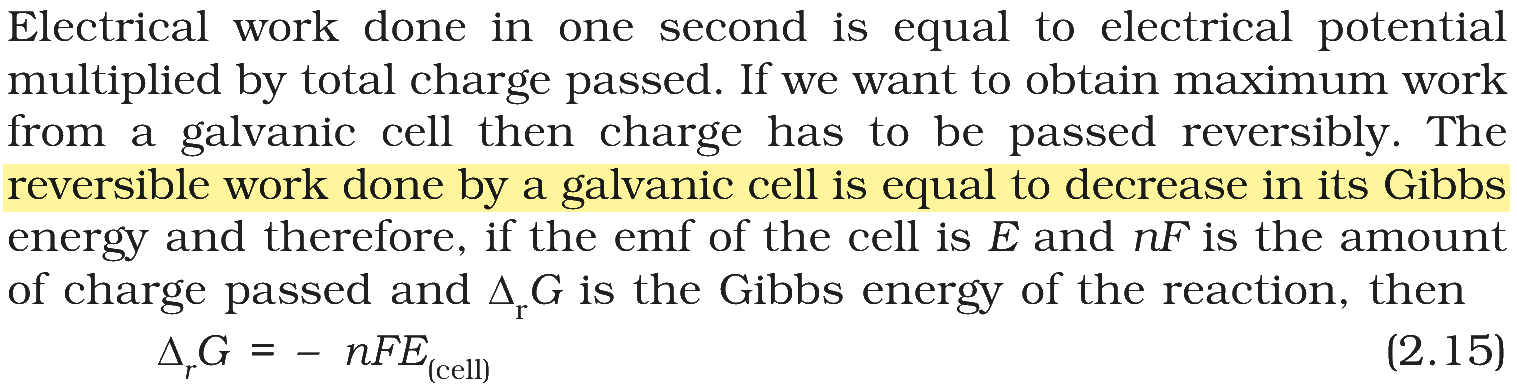
The maximum electrical work a galvanic cell can do equals the decrease in Gibbs energy of the cell reaction. When n moles of electrons pass through the cell, the charge is nF, and the work is charge times emf:
\( \displaystyle \Delta_r G = -nFE_{cell} \)
Here n is the number of electrons transferred in the balanced reaction:
\( \displaystyle \ce{Zn(s) -> Zn^2+(aq) + 2e^-} \qquad \ce{Cu^2+(aq) + 2e^- -> Cu(s)} \)
Two electrons pass from zinc to copper(II) ions, so n = 2 and
\( \displaystyle \Delta_r G = -2FE_{cell} \)
Why the other options are incorrect
Option (1) \(Δ_rG=-4FE_{cell}\) — Incorrect. Only two electrons are transferred per Zn atom; n = 4 would apply if the equation were doubled.
Option (3) \(Δ_rG=-1FE_{cell}\) — Incorrect. One electron would apply to a couple such as \( \ce{Ag+}/\ce{Ag} \); zinc and copper both change by two units of charge.
Option (4) \(Δ_rG=2FE_{cell}\) — Incorrect. The sign is wrong: the Daniell cell reaction is spontaneous, so \( E_{cell} \) is positive and \( \Delta_r G \) must be negative.
NCERT (2026-27 edition):
Electrochemical Cell and Gibbs Energy of the Reaction – …