CUETMOCK
  • Pricing
  • Mentors
Log inStart freeStart free mocks→

First test, then trust

Try a free CUET mock test.

Join 5,00,000+ students who rehearsed exam day on the exact NTA screen before sitting CUET. On the web and on Android.

Start free mocks →Get the Android app
CUETMOCK

India's #1 CUET Mock Test Platform. Original NCERT-based questions on the exact NTA exam screen — trusted by 5,00,000+ students since CUET 2022.

Get it onGoogle PlayScan to download the CUETMOCK app

Mock tests

  • CUET mock test series
  • Browse all papers
  • Commerce mocks
  • Humanities (Arts) mocks
  • Science mocks
  • Languages & GAT mocks
  • Free practice questions
  • Pricing

Resources

  • CUET exam guide
  • CUET syllabus
  • Universities accepting CUET
  • Expert blogs
  • News & notifications
  • Webinars & counselling
  • CUET score calculator
  • How we estimate your rank
  • FAQs

Company

  • About us
  • Our leadership & team
  • Our toppers
  • Mentors
  • For schools
  • Contact us
  • Terms
  • Privacy
  • Refund policy

Talk to us

+91 7696 6630 56info@cuetmock.comWhatsApp us

Our other platforms

  • JEE Mock — For IIT-JEE aspirants
  • NEET Mock — For NEET aspirants

Newsletter

Exam updates, study material and offers — no spam.

© 2026 NYC Ventures Pvt. Ltd.

701-702, Royal Business Park, Zirakpur, Punjab - 140603

  • Terms of use
  • Privacy policy
  • Refund policy
  • Contact us

iCUETMOCK is an independent preparation platform, not affiliated with the National Testing Agency (NTA). Always check exam details on the official NTA website.

  • Home
  • Mock tests
  • CUET guide
  • Pricing
  • Log in
Home/Practice questions/History
HistoryMedieval India: An Imperial Capital: Vijayanagara

Match the LIST-I with LIST-II:LIST-IDistinctive FeatureLIST-IIBuildin…

Match the LIST-I with LIST-II:

LIST-I
Distinctive Feature
LIST-II
Building/Place
A.Swing pavilionI.Vitthala temple
B.The ChariotII.Mahanavami dibba
C.Massive platformIII.Gingee
D.GopuramIV.Virupaksha temple

Choose the correct answer from the options given below:

Answer & explanation+

Correct answer: option 4

The correct answer is Option (4) → A - III, B - I, C - II, D - IV

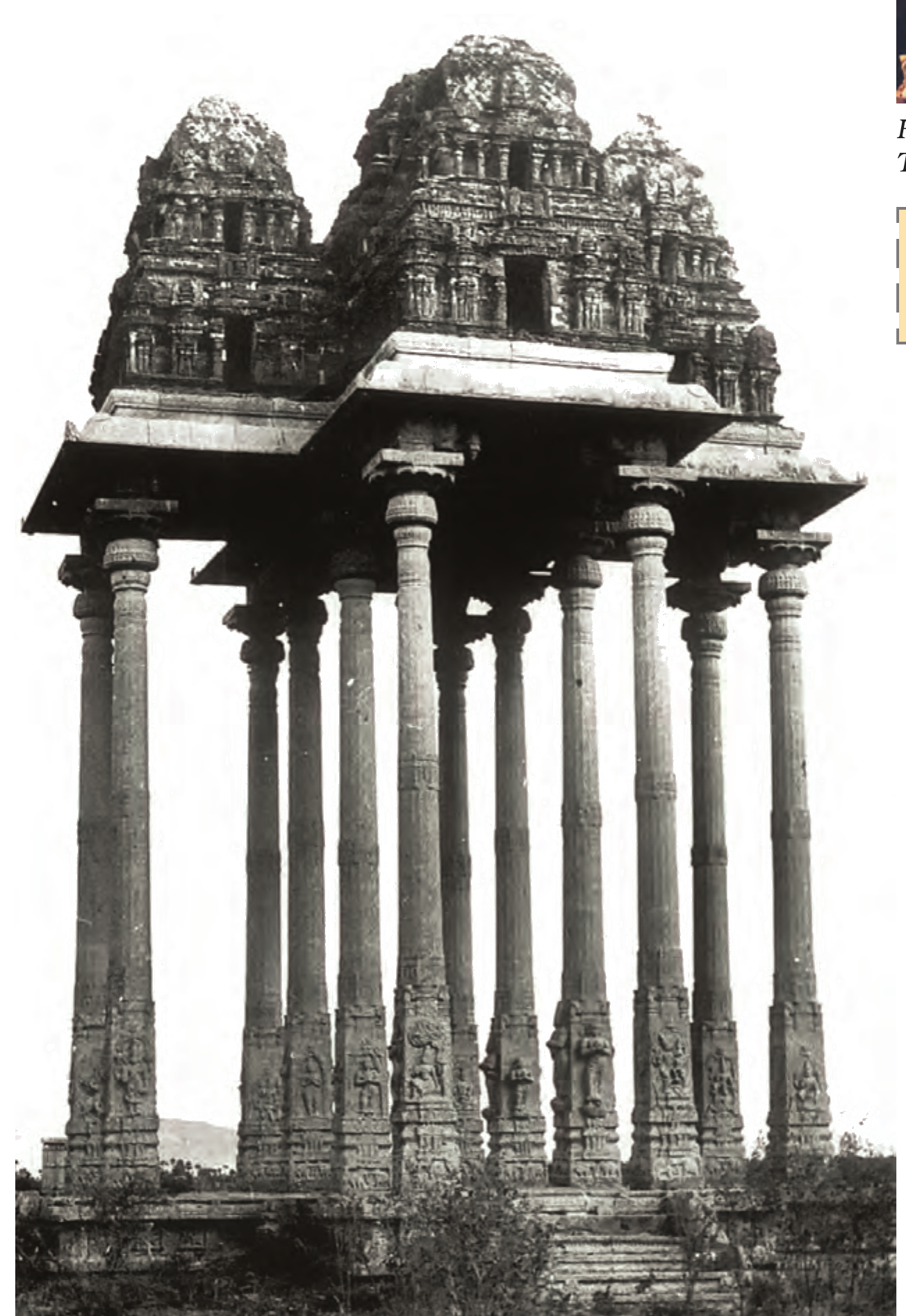
(A) Swing pavilion — this matches (III) Gingee. Temple halls of this period were used for many purposes, and some were meant for the deities to swing in. A well-known example of such a pavilion is the swing pavilion from Gingee.

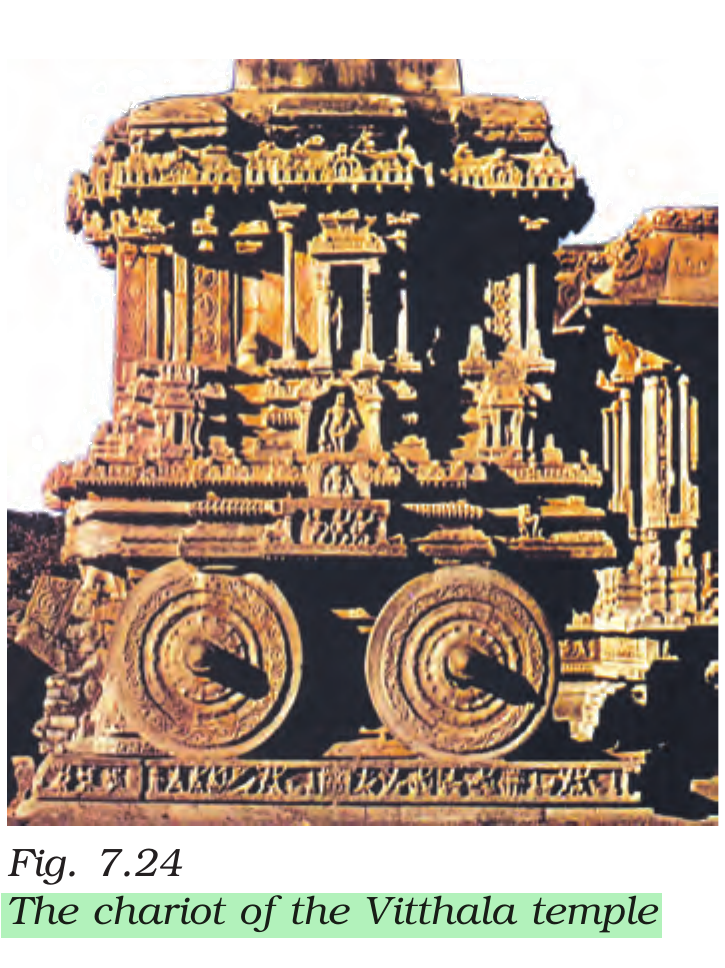
(B) The Chariot — this matches (I) Vitthala temple. The Vitthala temple has several halls and a unique shrine designed as a chariot. Its principal deity, Vitthala, was a form of Vishnu worshipped mainly in Maharashtra.

(C) Massive platform — this matches (II) Mahanavami dibba. The mahanavami dibba is a massive platform on one of the highest points of the city, rising from a base of about 11,000 sq. ft to a height of 40 ft. The rituals of the Mahanavami festival were probably held here.

(D) Gopuram — this matches (IV) Virupaksha temple. The Virupaksha temple was enlarged over the centuries. Krishnadeva Raya added a hall in front of the main shrine and is credited with the eastern gopuram, the tall gateway of the temple.


NCERT (2025-26): “4.1 The mahanavami dibba … Located on one of the highest points in the city, the ‘mahanavami dibba’ is a massive platform rising from a base of about 11,000 sq. ft to a height of 40 ft. There is evidence that it supported a wooden structure.…

5.2. Gopurams and mandapas … The Virupaksha temple was built over centuries. While inscriptions suggest that the earliest shrine dated to the ninth-tenth centuries, it was substantially enlarged with the establishment of the Vijayanagara Empire. The hall in front of the main shrine was built by Krishnadeva Raya to mark his accession. This was decorated with delicately carved pillars. He is also credited with the construction of the eastern gopuram. … The halls in the temple were used for a variety of purposes. Some were spaces in which the images of gods were placed to witness special programmes of music, dance, drama, etc. Others were used to celebrate the marriages of deities, and yet others were meant for the deities to swing in. Special images, distinct from those kept in the small central shrine, were used on these occasions. … As in the case of other temples, this temple too has several halls and a unique shrine designed as a chariot (Fig. 7.24).…”

NCERT extractNCERT extract

Fig. 7.25 Swing pavilion from Gingee

Advertisement

Practise more on Medieval India: An Imperial Capital: Vijayanagara

Chapter-wise mocks on the real NTA exam screen, with solutions and your rank. Your first mocks are free.

Start free mocks →

Advertisement

Next questions

  1. Who was the chairman of the House Committee of the Constituent Assembly of India?General Aptitude Test · General Knowledge
  2. Find value of tan7°.tan14°.tan21°.tan28°.tan83°.tan76°.tan69°.tan62°General Aptitude Test · Quantitative Reasoning
  3. Under the Mahatma Gandhi National Rural Employment Guarantee Act 2005, how many days of guaranteed wage employment are promised to all rura…Economics · Indian Economic Development: Employment - Growth, Informalisation and Other Issues
  4. Which of the following define the given statement 'Appropriation of a certain number of shares is made to an applicant in response to his a…Accountancy Part A · Accounting for Shares
  5. What does the change in current produce?Physics · Electromagnetic Induction
  6. The value of cos≤ft(sin^-11/4+sec^-14/3), isMaths. Section B1 · Inverse Trigonometric Functions
  7. The structure of the product of the following reaction isChemistry · Organic: Aldehydes, Ketones and Carboxylic Acids
  8. If ∫_0^k (2x+1) dx = 6 and k gt 0 , then the value of k isMaths. Section B1 · Definite Integration
  9. The line chart given below shows the salary of 6 employees of a company. What is the ratio of salary of F to the salary of H ?General Aptitude Test · Quantitative Reasoning
  10. ∫ e^x≤ft((1-x)/(1+x^2))^2 dx=Maths. Section A · Indefinite Integration (Section A)