
A series LCR circuit connected to an AC source with voltage of the source $v=v_m \sin \omega t$.
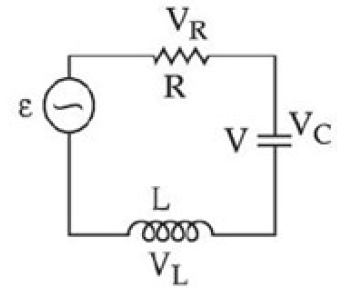
If 'q' is the charge on the capacitor and 'i' is the current, from Kirchoff's loop rule:
$L \frac{d i}{d t}+i R+\frac{q}{c}=V$
The current in the circuit is given by $i=I_{m} \sin (\omega t+\phi)$ where $\phi$ is the phase difference between the voltage across the source and current in the circuit.
We know $V_{R m}=L_m R ; V_{L m}=L_m X_L ; V_{C m}=L_m X_C$; and $X_L=\omega L ; X_C=\frac{1}{\omega C}$
Total impedance in the circuit regulates current. At resonance frequency of the LCR circuit current in the circuit is maximum.
In a series LCR circuit if frequency of the ac source is increased from resonance value $f_0$ to $2f_0$. Choose the statement depicting correct situation in the circuit.
Answer & explanation
Correct answer: option 1
The correct answer is Option (1) → Impedance of the circuit would increase
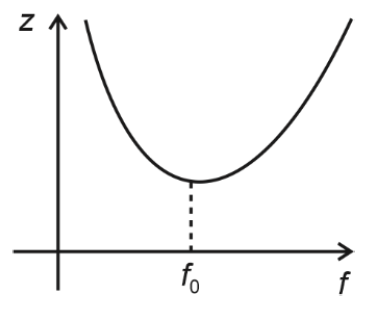
⇒ When frequency of the ac source is increased from $f_0$ to $2 f_0$ then impedance of the circuit increases.
$i_0=\sqrt{2} \times i_{\text {rms }} \Rightarrow i_0=\sqrt{2} \times \frac{V_{\text {rms }}}{z}$, or impedance value increases, amplitude of current decreases hence potential difference across resistance would decrease.
$i_{\text {rms }}=\frac{V_{\text {rms }}}{z}$, or $z↑ i_{\text {rms}}↓$
Potential difference across the series combination of L & C will be non-zero as it is not condition of resonance.