
Read the passage carefully and answer.
Organic compounds derived from $NH_3$ by replacing one or more H-atoms with alkyl or aryl groups will form primary, secondary and tertiary amines. The common methods which include their preparations are reduction of nitro group, amide group and nitrile group, Gabriel phthalimide synthesis and ammonolysis of alkyl halides. Amines are basic in nature due to the presence of a lone pair of electrons on the nitrogen atom. Important chemical properties of amines include acylation, alkylation and their interaction with nitrous acid. There are various tests which can distinguish different types of amines from each other, for e.g. carbylamine test, Hinsberg's test, coupling reaction etc. Another important class of compounds which can be derived from primary amines is azo compounds. These compounds are intensely colored and widely used as dyes in textile, leather and food industries.
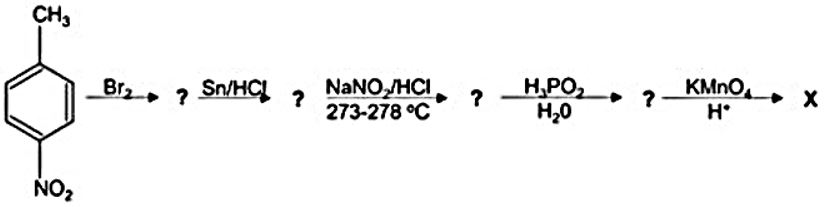
In the following sequence of the conversion, identify the final product (X)
Answer & explanation
Correct answer: option 3
The correct answer is Option (3).
Complete statement
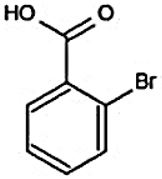
The final product formed is o-bromobenzoic acid.
Reasoning (step-by-step conversion)
1. Starting compound: p-nitrotoluene
2. $\text{Br}_2$ (bromination):
The methyl group ($-\text{CH}_3$) is ortho/para directing, so bromination occurs at the ortho position (para is already occupied by $\text{NO}_2$).
3. Sn/HCl (reduction):
The $-\text{NO}_2$ group is reduced to $-\text{NH}_2$
4. $\text{NaNO}_2$/HCl (273–278 K):
Forms diazonium salt ($-\text{N}_2^+\text{Cl}^-$)
5. $\text{H}_3\text{PO}_2$ / $\text{H}_2\text{O}$:
Replaces diazonium group with H (deamination)
6. $\text{KMnO}_4$ / $\text{H}^+$ (oxidation):
The $-\text{CH}_3$ group is oxidized to $-\text{COOH}$
Final structure
- COOH group (from $\text{CH}_3$ oxidation)
- Br at ortho position
Hence, the product is o-bromobenzoic acid
Conclusion
The correct answer is Option (3) $\rightarrow$ o-bromobenzoic acid.