
The reaction occurring at the cathode is
\(HgO + H_2O + 2e^- \longrightarrow Hg(l) + 2OH^-\)
The above reaction is found in :
Answer & explanation
Correct answer: option 2
The correct answer is Option (2) → Mercury cell
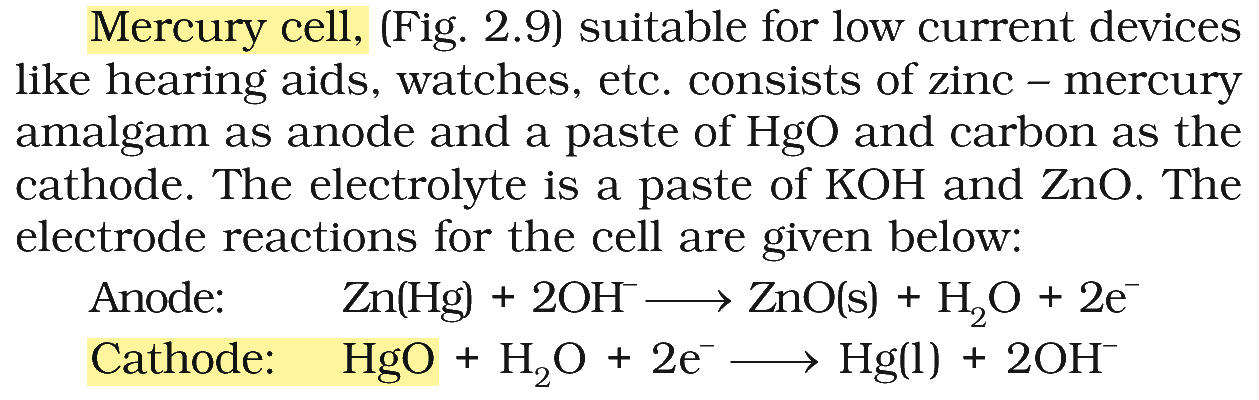
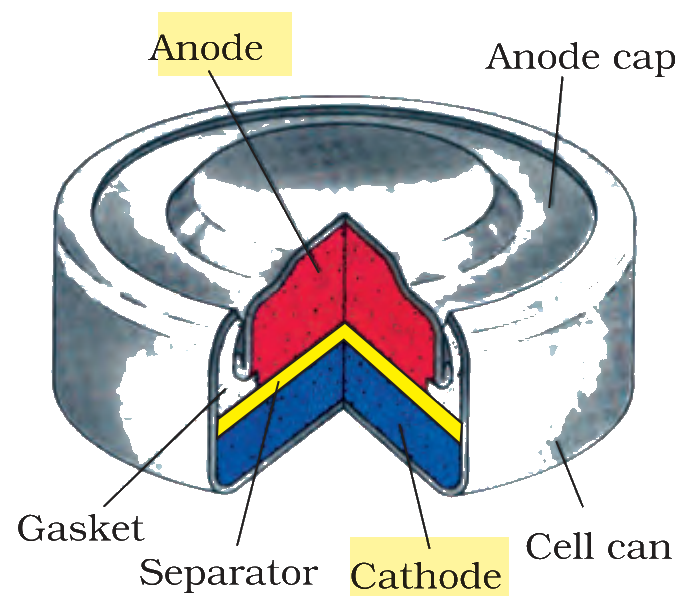
The mercury cell, used in hearing aids and watches, has a zinc–mercury amalgam anode, a paste of HgO and carbon as the cathode, and a paste of KOH and ZnO as the electrolyte.
Anode: \( \ce{Zn(Hg) + 2OH- -> ZnO(s) + H2O + 2e-} \)
Cathode: \( \ce{HgO + H2O + 2e- -> Hg(l) + 2OH-} \)
Why the other options are incorrect
Option (1) Leclanché cell — Incorrect. In the dry cell the cathode reaction is \( \ce{MnO2 + NH4+ + e- -> MnO(OH) + NH3} \).
Option (3) Fuel cell — Incorrect. In the \( \ce{H2-O2} \) fuel cell the cathode reaction is \( \ce{O2 + 2H2O + 4e- -> 4OH-} \).
Option (4) Ni-Cd cell — Incorrect. The cathode reaction involves nickel(IV) oxide/hydroxide, not HgO.
NCERT (2026-27 edition):
Primary Batteries – …
Note: The same/similar question has been asked in different years by NTA as per the details given below:
| 2026 | 2025 | 2024 | 2023 | 2022 |
|---|---|---|---|---|
| – | – | – | 02-06 S3 31-05 S1 | – |