A manager realized that in spite of the best efforts put in by his workers, the target could not be achieved. 'Obsolete machinery' was the cause of deviation.
Suggest from the following, a corrective action that could be appropriate to overcome the ongoing problem.
Answer & explanation
Correct answer: option 3
The correct answer is Option (3) → Undertake technological upgradation of machine
Option (1) Repair of the existing machine — Incorrect. Repair is the action when the machinery is defective. Here the machinery is obsolete, so repairing an out-of-date machine will not solve the problem.
Option (2) Improve the physical conditions of work — Incorrect. This is the action for defective physical conditions of work. The cause given here is obsolete machinery.
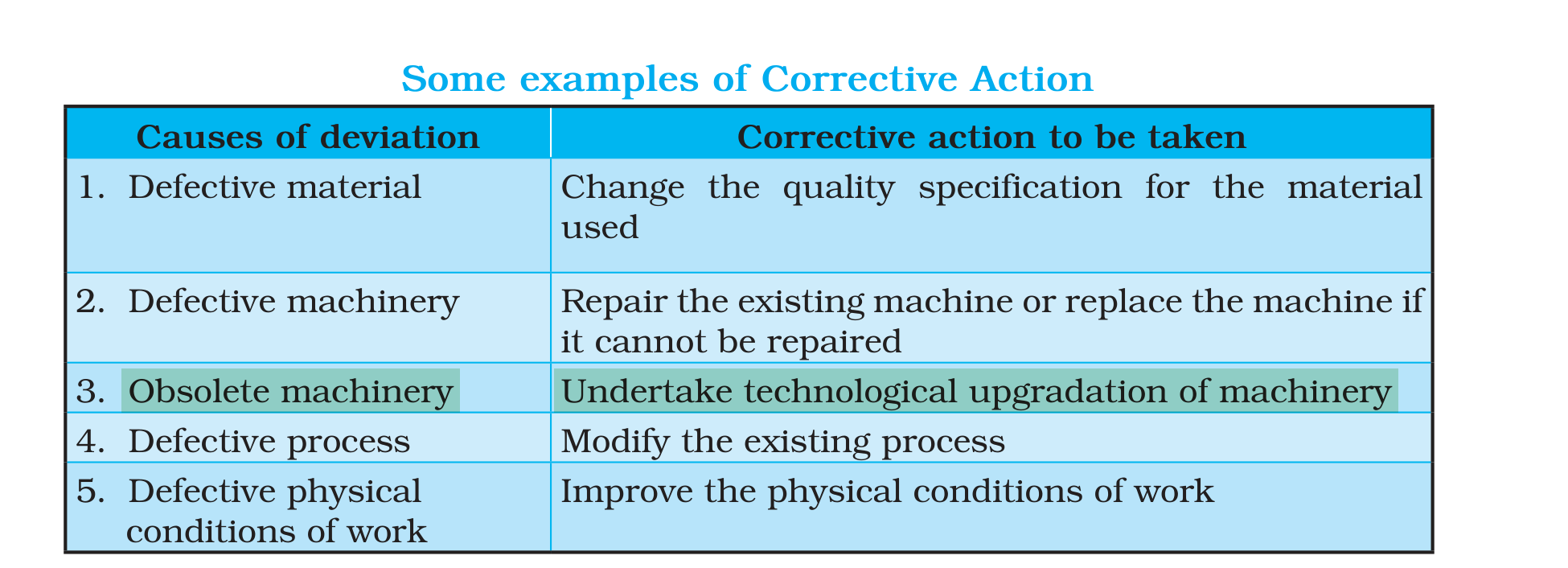
Option (3) Undertake technological upgradation of machine — Correct. For the cause “obsolete machinery”, the corrective action is technological upgradation of machinery.
Option (4) Modify the existing process — Incorrect. This is the action for a defective process. The cause given here is obsolete machinery.
Note: The current NCERT book (2026-27) only says that a table of the causes of deviations and the respective corrective actions follows. The table itself is given in the pre-rationalised NCERT, from which the screenshot below is taken. NCERT (2026-27 Edition): “Corrective action might involve training of employees if the production target could not be met. Similarly, if an important project is running behind schedule, corrective action might involve assigning of additional workers and equipment to the project and permission for overtime work. In case the deviation cannot be corrected through managerial action, the standards may have to be revised. The table below cites some of the causes of deviations and the respective corrective action that might be taken by a manager.” NCERT (Pre-rationalised Edition):
|