
A parallel plate capacitor is connected to a battery through a key K as shown.
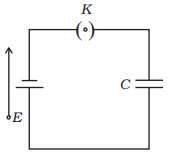
A slab of dielectric constant 2 that completely fills the space between the plates is inserted in two cases:
Case I: The slab is inserted while the capacitor is still connected to the battery (K closed).
Case II: The key K is opened after the capacitor is fully charged, and then the slab is inserted.
Which of the following statements are correct?
(A) In Case I, the charge on the capacitor increases.
(B) In Case I, the energy stored in the capacitor increases.
(C) In Case II, the potential difference across the capacitor decreases.
(D) In Case II, the energy stored in the capacitor increases.
Choose the correct answer from the options given below:
Answer & explanation
Correct answer: option 1
The correct answer is Option (1) → (A), (B) and (C) only
A dielectric slab that fills the whole gap raises the capacitance by the factor \( K \), so with \( K=2 \) the capacitance becomes \( C=2C_0 \). From the figure, the key K joins the capacitor to the battery. Whether K is closed or open decides what stays fixed while the slab goes in.
Case I: K stays closed, so the battery holds the potential difference fixed at \( V_0 \).
Case II: the capacitor is charged to \( Q_0=C_0V_0 \) and K is then opened. No charge can now flow on or off the plates, so the charge stays fixed at \( Q_0 \).
(A) In Case I, the charge on the capacitor increases. — True. With \( V_0 \) fixed, the charge \( Q=CV_0 \) grows with \( C \). It becomes \( 2C_0V_0 \), twice the earlier value, as the battery sends more charge to the plates.
(B) In Case I, the energy stored in the capacitor increases. — True. The stored energy is \( U=\frac{1}{2}CV_0^{2} \). For the same \( V_0 \) it doubles when \( C \) doubles.
(C) In Case II, the potential difference across the capacitor decreases. — True. With the charge fixed at \( Q_0 \), the potential difference after the slab is put in is:
\( \begin{aligned} V &= \frac{Q_0}{2C_0} \\ &= \frac{V_0}{2} \end{aligned} \)
(D) In Case II, the energy stored in the capacitor increases. — False. For a fixed charge the energy is \( U=Q_0^{2}/2C \), so when \( C \) doubles, the stored energy falls to half its earlier value.
NCERT (2026-27):
Effect of Dielectric on Capacitance – “… the dielectric constant of a substance is the factor (>1) by which the capacitance increases from its vacuum value, when the dielectric is inserted fully between the plates of a capacitor.”
Summary – “12. The energy U stored in a capacitor of capacitance C, with charge Q and voltage V is”
\( \displaystyle U=\frac{1}{2}QV=\frac{1}{2}CV^{2}=\frac{1}{2}\frac{Q^{2}}{C} \)