
Two men on either side of a pole of 30 m high observe its top at angles of elevation α and β respectively. The distance between the two men is \(40\sqrt{3}\) m and the distance between the first man at A and the pole is \(30\sqrt{3}\) m.
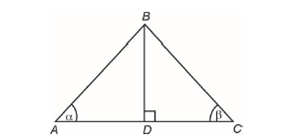
Based on the above information, answer the question:
The value of \(\displaystyle\frac{1}{AB^2}+\frac{1}{BC^2}\) is:
Answer & explanation
Correct answer: option 1
The correct answer is Option (1) → \(\displaystyle\frac{1}{BD^2}\)
The pole is BD = 30 m, with AD = \(30\sqrt{3}\) m and AC = \(40\sqrt{3}\) m, so
\(DC = 40\sqrt{3} - 30\sqrt{3} = 10\sqrt{3}\)
By Pythagoras’ theorem in the right triangles ABD and CBD:
\(AB^2 = AD^2 + BD^2 = 2700 + 900 = 3600\)
\(BC^2 = DC^2 + BD^2 = 300 + 900 = 1200\)
\( \displaystyle \frac{1}{AB^2}+\frac{1}{BC^2} = \frac{1}{3600}+\frac{3}{3600} = \frac{4}{3600} = \frac{1}{900} \)
Since \(BD^2 = 900\), this equals \(\frac{1}{BD^2}\).