
A and B together can do a work in 9 days. B and C can finish the same work in \(\frac{90}{7}\) days. A started the work and worked for 3 days. B and C continued for 9 days. Then the diffference of days in which C and A can complete the job is?
Answer & explanation
Correct answer: option 1
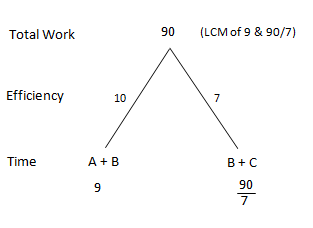
(B+ C)'s 9 days work = 9 × 7 = 63
Remaining work = 90 - 63 = 27
This was done by A in 3 days
Efficiency of A = \(\frac{27}{3}\) = 9 unit/day
A + B = 10 (eff)
B's efficiency = 10 - 9 = 1 unit/day
B + C = 7 unit/day
C's efficiency = 7 - 1 = 6 unit/day
C will take = \(\frac{90}{6}\) = 15 days to finish the work
A will take = \(\frac{90}{9}\) = 10 days to finish the work
Diff = C - A = 15 - 10 = 5 days