
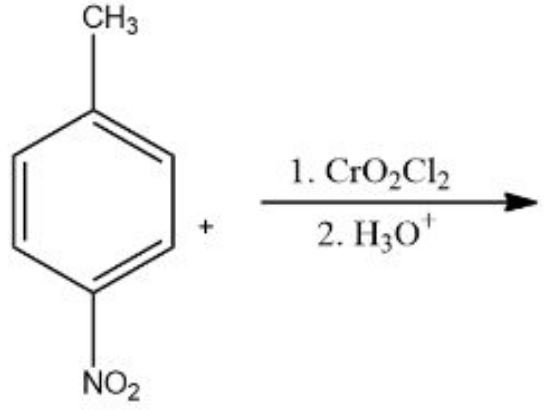
The product in the following chemical reaction is
Answer & explanation
Correct answer: option 2
The correct answer is Option (2) → p-nitrobenzaldehyde
Strong oxidising agents oxidise the methyl group of toluene and its derivatives all the way to a carboxyl group. To stop at the aldehyde stage, a reagent is used that turns the methyl group into an intermediate that is hard to oxidise further. In the Etard reaction, chromyl chloride, \( \ce{CrO2Cl2} \), oxidises the methyl group to a chromium complex, and hydrolysis of the complex gives the benzaldehyde.
Here the starting compound is 4-nitrotoluene. Only the methyl group reacts; the nitro group is not affected:
\( \displaystyle p\text{-}\ce{O2N-C6H4-CH3} \xrightarrow[\text{(ii) }\ce{H3O+}]{\text{(i) }\ce{CrO2Cl2}\text{, }\ce{CS2}} p\text{-}\ce{O2N-C6H4-CHO} \)
So the product is p-nitrobenzaldehyde, the structure in Option (2).
Why the other options are incorrect
Option (1) p-nitrobenzoic acid — Incorrect. This would be formed by a strong oxidising agent such as acidified \( \ce{KMnO4} \), which oxidises the side chain fully to –COOH; chromyl chloride stops at –CHO.
Option (3) p-hydroxybenzoic acid — Incorrect. Chromyl chloride does not change the nitro group into an –OH group; that would need reduction to –\( \ce{NH2} \), diazotisation and warming with water.
Option (4) 3-chloro-4-nitrobenzoic acid — Incorrect. The chlorine of chromyl chloride does not enter the ring, and the side chain stops at the aldehyde, not the acid.
NCERT (2026-27 edition):
By Oxidation of Methylbenzene – “… (a) Use of chromyl chloride (CrO2Cl2): Chromyl chloride oxidises methyl group to a chromium complex, which on hydrolysis gives corresponding benzaldehyde. This reaction is called Etard reaction.”