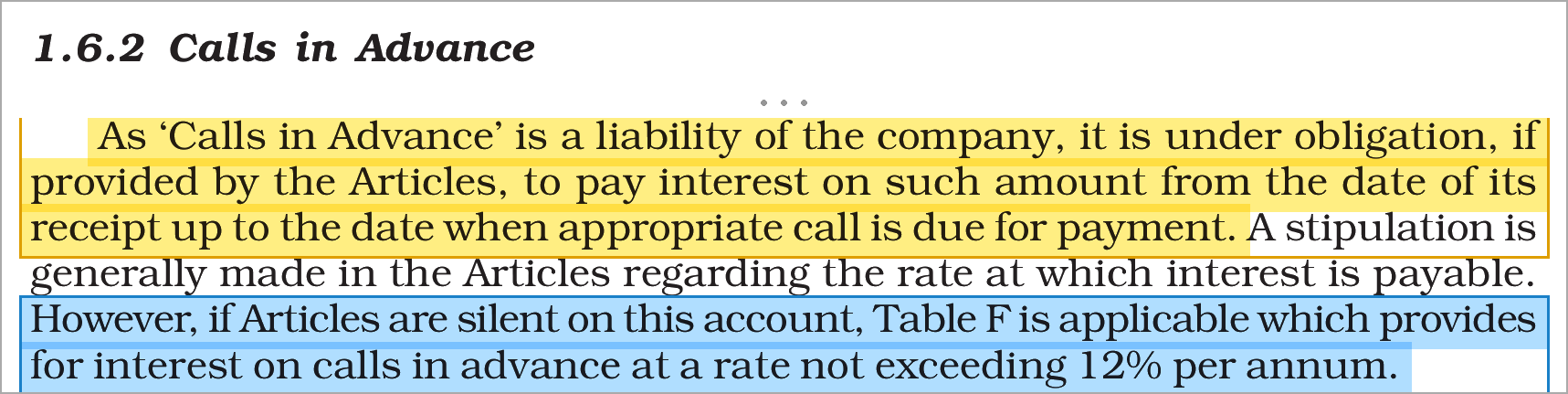
As 'Calls in Advance' is a liability of the company, it is under obligation, if provided by the Articles, to pay interest on that amount from the date of its receipt up to the date when the appropriate call is due for payment. According to "Table F", interest on calls in advance cannot exceed _____.
Answer & explanation
Correct answer: option 3
The correct answer is Option (3) → 12%
Where the Articles fix a rate of interest on calls in advance, that rate governs. Where they are silent, Table F of the Companies Act, 2013 applies, and it allows interest on calls in advance at a rate not exceeding 12% per annum.
Interest runs from the date the money is received to the date the call actually falls due — not to the date of payment of the call. The company pays it because the money is a liability in its hands, not part of paid-up capital, and it earns the shareholder nothing until the call is made.
Tip: Table F carries two rates and they are easy to swap. Calls in advance → 12%, paid by the company; calls in arrears → 10%, charged to the shareholder. Advance is the bigger number, because the company is the one using somebody else’s money.
NCERT Extract