The 73rd Constitutional Amendment provides:
(A) A two-tier system of Panchayati Raj.
(B) Constitutional status to the Panchayati Raj institutions.
(C) Reservation of seats for the Scheduled Castes and Scheduled Tribes in Panchayati Raj institutions.
(D) Thirty-three percent seats for women in all offices of local bodies.
Choose the correct answer from the options given below:
Answer & explanation
Correct answer: option 4
The correct answer is Option (4) → (B), (C) and (D) only
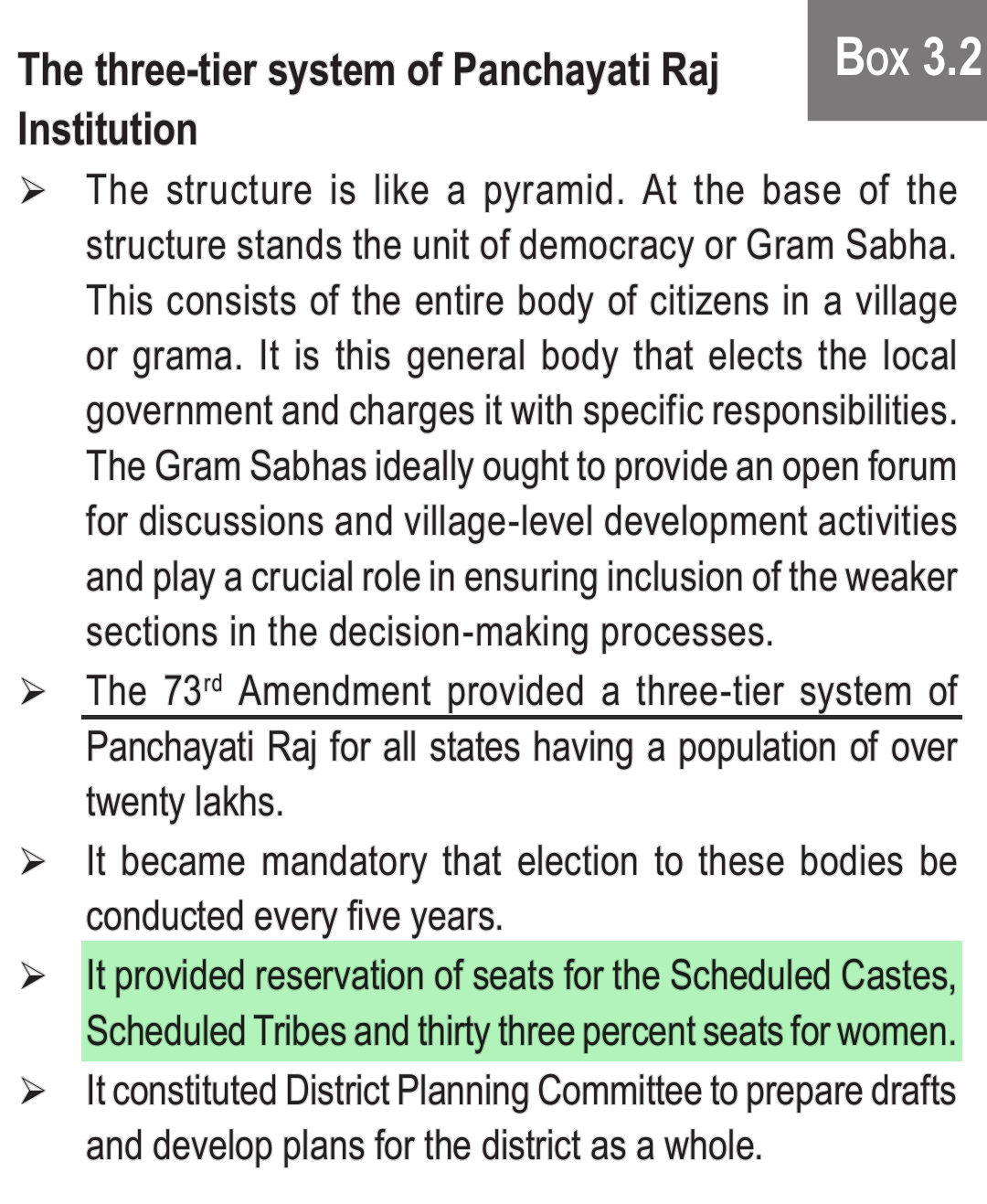
(A) A two-tier system of Panchayati Raj. Incorrect. The 73rd Amendment provided a three-tier system of Panchayati Raj for all states having a population of over twenty lakhs, not a two-tier one.
(B) Constitutional status to the Panchayati Raj institutions. Correct. Grassroot democracy was ushered in only in 1992 by the 73rd Constitutional Amendment, which provided constitutional status to the Panchayati Raj Institutions (PRIs); elections to these bodies every five years became compulsory.
(C) Reservation of seats for the Scheduled Castes and Scheduled Tribes in Panchayati Raj institutions. Correct. The Amendment provided reservation of seats for the Scheduled Castes and Scheduled Tribes.
(D) Thirty-three percent seats for women in all offices of local bodies. Correct. It reserved thirty-three percent (one third) of the seats for women in all elected offices of local bodies, in rural and urban areas.
NCERT (2025-26): “Ideals of Panchayati Raj … It was, however, only in 1992 that grassroot democracy or decentralised governance was ushered in by the 73rd Constitutional Amendment. This act provided constitutional status to the Panchayati Raj Institutions (PRIs). It is compulsory now for local self-government bodies in rural and municipal areas to be elected every five years.…” “The 73rd and 74th amendments to the Constitution ensured the reservation of one third of the total seats for women in all elected offices of local bodies in both the rural and urban areas.…”
|