Which of the following cause and facts are true about positive deviations from ideal behavior of solutions?
(A) A-B interactions are weaker than those between A-A and B-B
(B) CS2 - Acetone solution shows positive deviation.
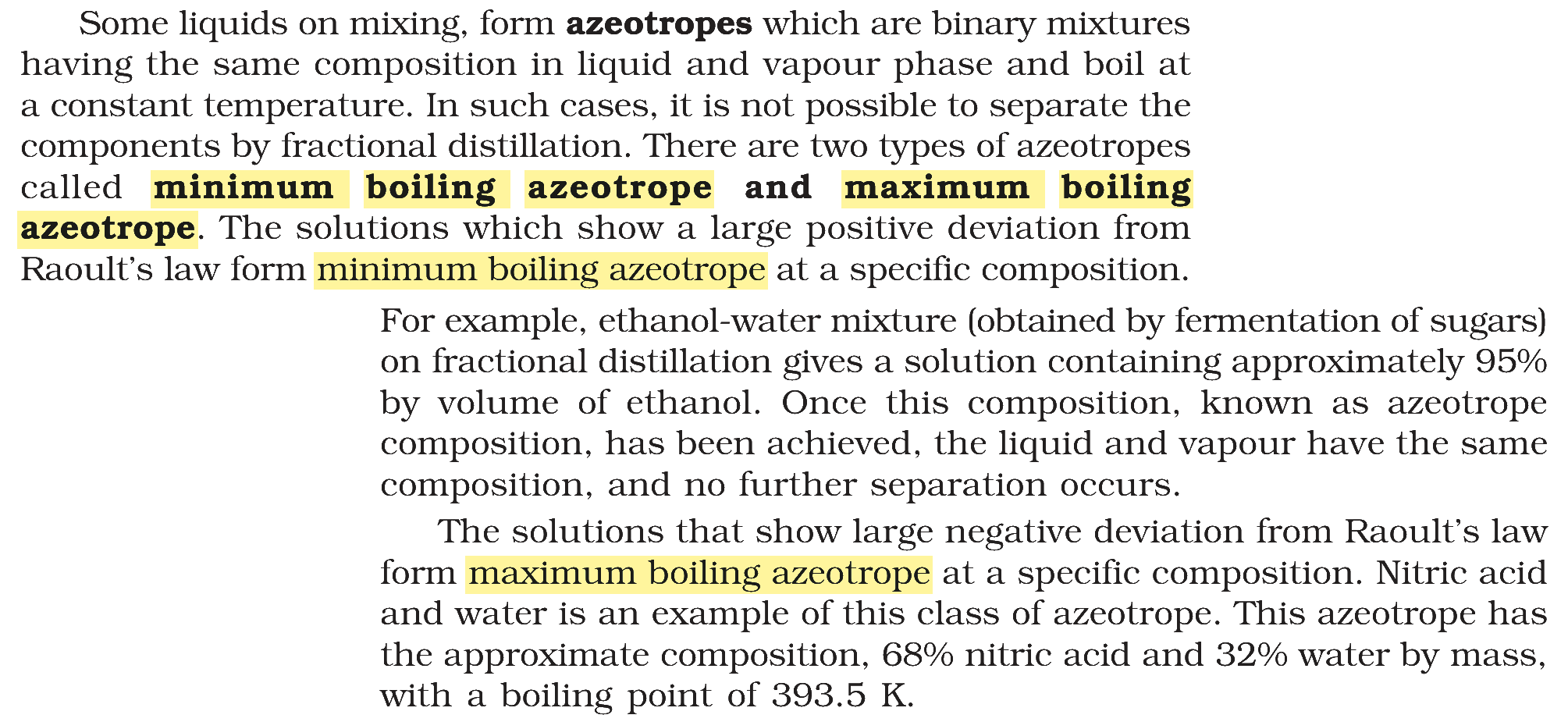
(C) Minimum boiling azeotrope is observed in positive deviation,
(D) Maximum boiling azeotrope is observed in positive deviation
Choose the correct answer from the options given below:
Answer & explanation
Correct answer: option 3
The correct answer is Option (3) → (A), (B) and (C) only
An ideal solution obeys Raoult’s law at all concentrations. This happens when the A–B interactions are about as strong as the A–A and B–B interactions. When they differ, the solution shows a deviation:
Positive deviation: A–B interactions are weaker. Molecules escape more easily, so the vapour pressure is higher than Raoult’s law predicts, and ΔmixH > 0. Examples are ethanol + acetone and carbon disulphide + acetone. A large positive deviation gives a minimum boiling azeotrope (for example, ethanol + water at about 95% ethanol).
Negative deviation: A–B interactions are stronger. The vapour pressure is lower than predicted, and ΔmixH < 0. Examples are chloroform + acetone and nitric acid + water. A large negative deviation gives a maximum boiling azeotrope (for example, nitric acid + water at about 68% nitric acid).
(A) A-B interactions are weaker than those between A-A and B-B — Correct. This is the cause of positive deviation.
(B) CS2 - Acetone solution shows positive deviation. — Correct. Carbon disulphide weakens the dipolar attractions between acetone molecules, so this mixture shows positive deviation.
(C) Minimum boiling azeotrope is observed in positive deviation, — Correct. The higher vapour pressure lowers the boiling point, giving a minimum boiling azeotrope.
(D) Maximum boiling azeotrope is observed in positive deviation — Incorrect. A maximum boiling azeotrope comes from negative deviation.
NCERT (2026-27 edition):
Non-ideal Solutions – “… In case of positive deviation from Raoult’s law, A-B interactions are weaker than those between A-A or B-B, i.e., in this case the intermolecular attractive forces between the solute-solvent molecules are weaker than those between the solute-solute and solvent-solvent molecules. … In a solution formed by adding carbon disulphide to acetone, the dipolar interactions between solute-solvent molecules are weaker than the respective interactions among the solute-solute and solvent-solvent molecules. This solution also shows positive deviation.”
Non-ideal Solutions – …