
The end product [B] in the following sequence of reactions is:

Answer & explanation
Correct answer: option 4
The correct answer is Option (4) → \(CH_3COOH\)
The sequence is a nucleophilic substitution followed by hydrolysis of a nitrile; together they add one carbon atom to the chain.
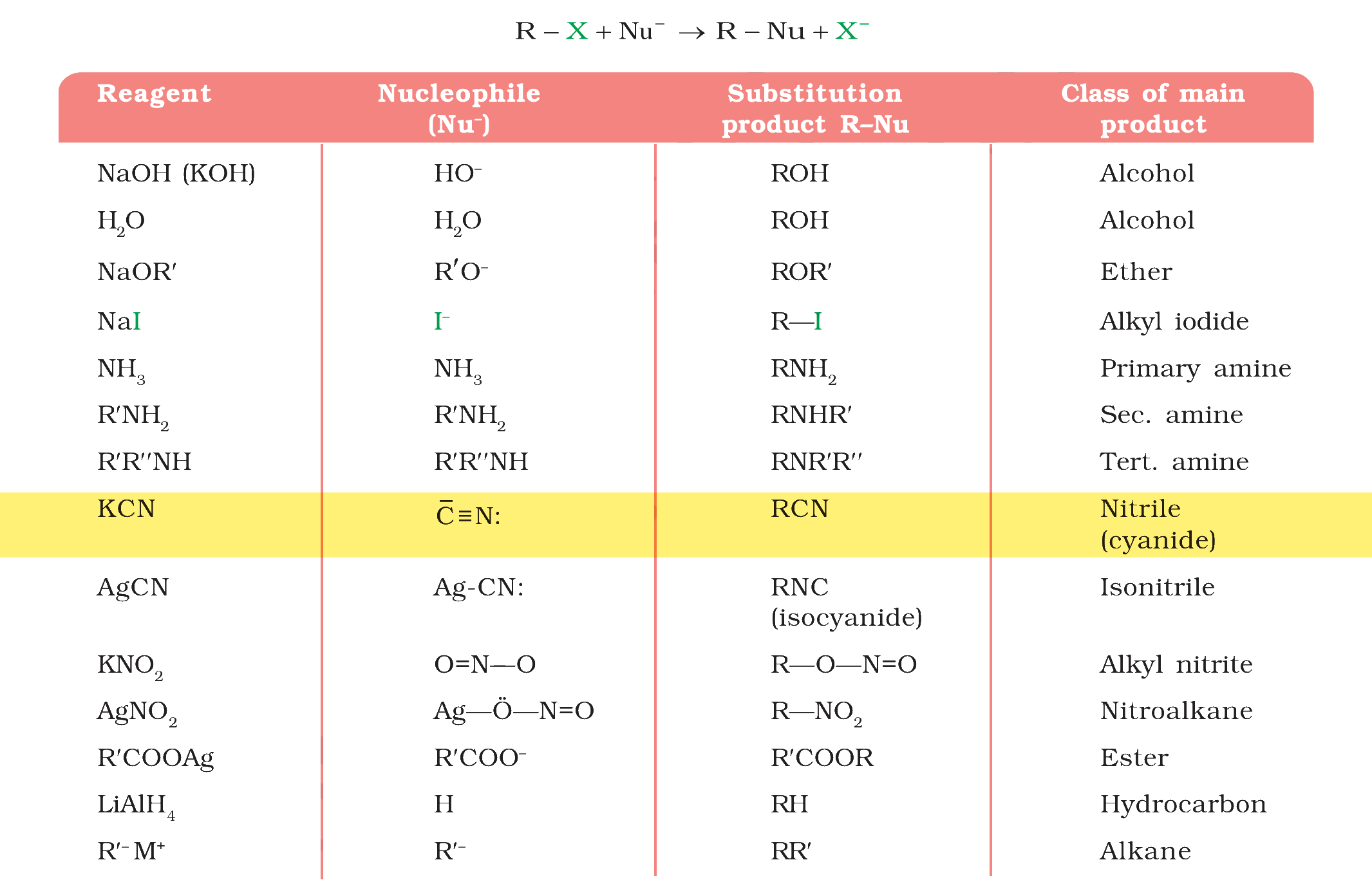
[A]: the cyanide ion of KCN replaces chlorine in chloromethane and gives ethanenitrile (methyl cyanide):
\( \displaystyle \ce{CH3Cl + KCN -> CH3CN + KCl} \)
[B]: in acid, the nitrile is hydrolysed first to the amide and then to the carboxylic acid, ethanoic acid:
\( \displaystyle \ce{CH3CN + H2O} \xrightarrow{\ce{H^+}} \ce{CH3CONH2} \)
\( \displaystyle \ce{CH3CONH2 + H2O} \xrightarrow{\ce{H^+}} \ce{CH3COOH + NH3} \)
(In the acid solution the ammonia is held as \( \ce{NH4^+} \).)
Why the other options are incorrect
Option (1) \(HCOOH\) — Incorrect. Methanoic acid has only one carbon, but the –CN group adds a carbon to the methyl group, so [B] has two carbons.
Option (2) \(CH_3COCH_3\) — Incorrect. Hydrolysis of a nitrile gives a carboxylic acid, not a ketone; propanone also has three carbons.
Option (3) \(CH_3NH_2\) — Incorrect. Methanamine would come from \( \ce{CH3Cl} \) and ammonia, not from KCN followed by hydrolysis.
NCERT (2026-27 edition):
Table 6.4: Nucleophilic Substitution of Alkyl Halides (R–X)
3. From nitriles and amides – “Nitriles are hydrolysed to amides and then to acids in the presence of H+ or OH− as catalyst.”