Match the LIST-I with LIST-II.
| LIST-I Metal Carbonyl Complex | LIST-II Geometry-structure |
| A. [Fe(CO)5] | I. Tetrahedral |
| B. [Mn2(CO)10] | II. Octahedral |
| C. [Ni(CO)4] | III. Trigonal bipyramidal |
| D. [Cr(CO)6] | IV. Two Square pyramidal units joined by a Metal – Metal bond |
Choose the correct answer from the options given below:
Answer & explanation
Correct answer: option 3
The correct answer is Option (3) → A-III, B-IV, C-I, D-II
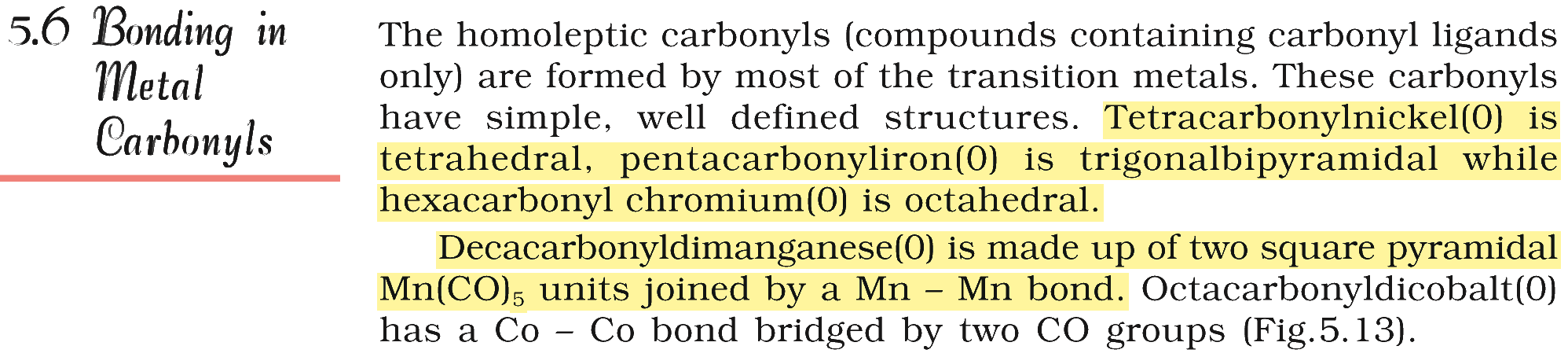
In the homoleptic metal carbonyls the metal is in the zero oxidation state, and the shape follows from the number of CO groups around each metal atom: 4 gives tetrahedral, 5 gives trigonal bipyramidal and 6 gives octahedral.
(A) \( \ce{[Fe(CO)5]} \) — This matches (III) Trigonal bipyramidal. Five CO groups surround the Fe atom.
(B) \( \ce{[Mn2(CO)10]} \) — This matches (IV) Two Square pyramidal units joined by a Metal – Metal bond. Each Mn carries five CO groups in a square pyramid, and the two \( \ce{Mn(CO)5} \) units are joined by a Mn–Mn bond.
(C) \( \ce{[Ni(CO)4]} \) — This matches (I) Tetrahedral. Four CO groups surround the Ni atom.
(D) \( \ce{[Cr(CO)6]} \) — This matches (II) Octahedral. Six CO groups surround the Cr atom.
Shortcut: (A)–(III) appears in Options (3) and (4), and (B)–(IV) then leaves only Option (3).
NCERT (2026-27 edition):
Bonding in Metal Carbonyls – …