
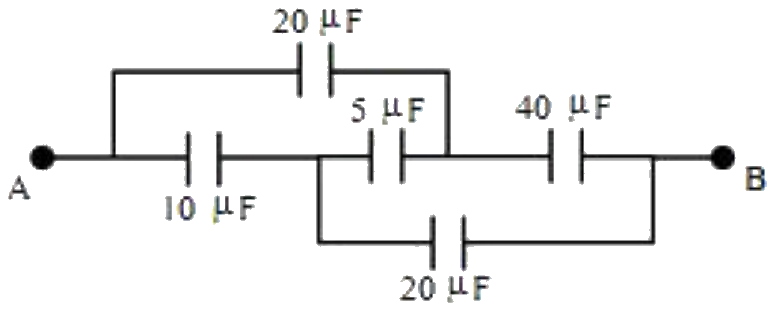
The equivalent capacitance between the points A and B in the network given below is
Answer & explanation
Correct answer: option 1
The correct answer is Option (1) → \( 20\,\mu\mathrm{F} \)
Call P the junction after the \( 10\,\mu\mathrm{F} \) capacitor and Q the junction after the \( 5\,\mu\mathrm{F} \) capacitor. Then
\( C_{AP} = 10\,\mu\mathrm{F} \)
\( C_{AQ} = 20\,\mu\mathrm{F}\ (\text{top}) \)
\( C_{PB} = 20\,\mu\mathrm{F}\ (\text{bottom}) \)
\( C_{QB} = 40\,\mu\mathrm{F} \)
\( C_{PQ} = 5\,\mu\mathrm{F} \)
This is a Wheatstone bridge of capacitors with the \( 5\,\mu\mathrm{F} \) capacitor in the middle. The bridge is balanced, because
\( \displaystyle \frac{C_{AP}}{C_{PB}} = \frac{10}{20} = \frac{1}{2} \quad\text{and}\quad \frac{C_{AQ}}{C_{QB}} = \frac{20}{40} = \frac{1}{2} \)
So P and Q are at the same potential, the \( 5\,\mu\mathrm{F} \) capacitor holds no charge and can be removed. What remains is two series pairs in parallel.
\( \displaystyle C_{APB} = \frac{10 \times 20}{10 + 20} = \frac{20}{3}\,\mu\mathrm{F} \)
\( \displaystyle C_{AQB} = \frac{20 \times 40}{20 + 40} = \frac{40}{3}\,\mu\mathrm{F} \)
\( \displaystyle C_{AB} = \frac{20}{3} + \frac{40}{3} = 20\,\mu\mathrm{F} \)