CUETMOCK
  • Pricing
  • Mentors
Log inStart freeStart free mocks→

First test, then trust

Try a free CUET mock test.

Join 5,00,000+ students who rehearsed exam day on the exact NTA screen before sitting CUET. On the web and on Android.

Start free mocks →Get the Android app
CUETMOCK

India's #1 CUET Mock Test Platform. Original NCERT-based questions on the exact NTA exam screen — trusted by 5,00,000+ students since CUET 2022.

Get it onGoogle PlayScan to download the CUETMOCK app

Mock tests

  • CUET mock test series
  • Browse all papers
  • Commerce mocks
  • Humanities (Arts) mocks
  • Science mocks
  • Languages & GAT mocks
  • Free practice questions
  • Pricing

Resources

  • CUET exam guide
  • CUET syllabus
  • Universities accepting CUET
  • Expert blogs
  • News & notifications
  • Webinars & counselling
  • CUET score calculator
  • How we estimate your rank
  • FAQs

Company

  • About us
  • Our leadership & team
  • Our toppers
  • Mentors
  • For schools
  • Contact us
  • Terms
  • Privacy
  • Refund policy

Talk to us

+91 7696 6630 56info@cuetmock.comWhatsApp us

Our other platforms

  • JEE Mock — For IIT-JEE aspirants
  • NEET Mock — For NEET aspirants

Newsletter

Exam updates, study material and offers — no spam.

© 2026 NYC Ventures Pvt. Ltd.

701-702, Royal Business Park, Zirakpur, Punjab - 140603

  • Terms of use
  • Privacy policy
  • Refund policy
  • Contact us

iCUETMOCK is an independent preparation platform, not affiliated with the National Testing Agency (NTA). Always check exam details on the official NTA website.

  • Home
  • Mock tests
  • CUET guide
  • Pricing
  • Log in
Home/Practice questions/Sociology
SociologyIndian Society: Patterns of Social Inequality and Exclusion

Agnes who was born 'male', chose to be identified as a 'female'. Whic…

Agnes who was born 'male', chose to be identified as a 'female'. Which of the following terms can she be associated with?

Answer & explanation+

Correct answer: option 2

The correct answer is Option (2) → Trans Gender

Option (1) Third Gender — Incorrect. Third gender is the social category of persons who are neither male nor female. Agnes identifies herself as a woman, so she belongs to one of the two genders, the one opposite to her birth.

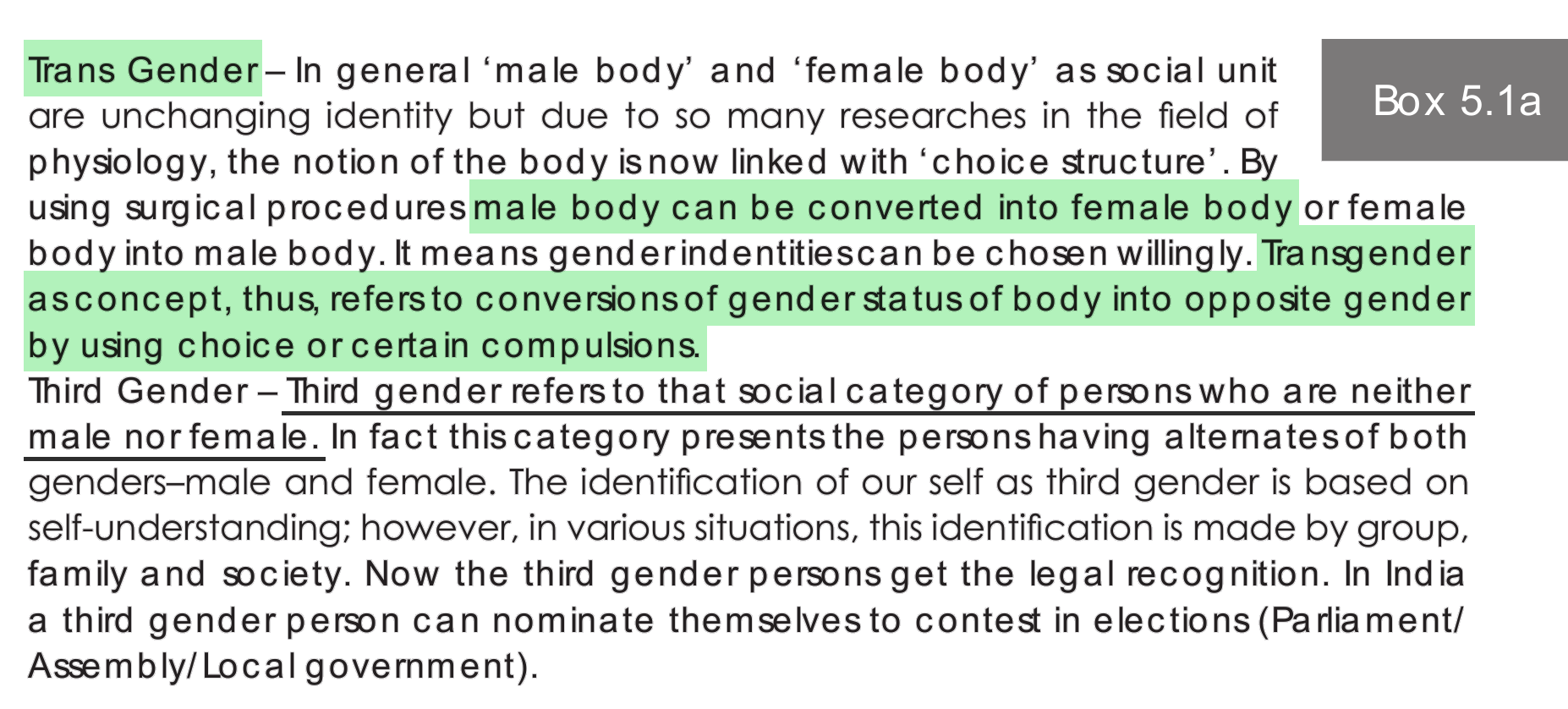
Option (2) Trans Gender — Correct. The male body and the female body were long seen as an unchanging identity, but today gender identity can be chosen. Transgender, as a concept, refers to the conversion of the gender status of the body into the opposite gender, by choice or under certain compulsions. Agnes was born male and has chosen to be identified as female.

Option (3) Non-Gender — Incorrect. Agnes has not given up gender; she has chosen a gender, female, so a label meaning ‘without gender’ does not describe her.

Option (4) Cis-Gender — Incorrect. A cis-gender person’s gender identity is the same as the sex recorded at birth. Agnes’s identity is the opposite of hers, so she is not cis-gender.

Note: The concept in Option (4), ‘Cis-Gender’, is not in NCERT (2025-26); explained here for the benefit of the students.


NCERT (2025-26): “…In this chapter we focus on four such groups who have suffered from serious social inequality and exclusion, namely Dalits or the ex-untouchable castes; adivasis or communities refered to as ‘tribal’; women, and the differently abled. We attempt to look at each of their stories of struggles and achievements in the following sections. Apart from these four groups, there are two more groups included in this category like transgender and people of third gender group. Information about these groups are given in Box 5.1a.…”

NCERT extract

Advertisement

Practise more on Indian Society: Patterns of Social Inequality and Exclusion

Chapter-wise mocks on the real NTA exam screen, with solutions and your rank. Your first mocks are free.

Start free mocks →

Advertisement

Next questions

  1. What is the meaning of the term 'jins-i-kamil' in the Indo-Persian sources of Mughal period?History · Medieval India: Peasants, Zamindars and the State
  2. Which part of the Indian Constitution deals with Fundamental Rights?General Aptitude Test · General Knowledge
  3. The value of sec≤ft(tan^-1≤ft(-displaystyle3/4)) isMaths. Section B1 · Inverse Trigonometric Functions
  4. The unit's digit of 12^12 is equal to:Applied Maths. Section B2 · Numbers, Quantification and Numerical Applications
  5. Which of the following is correct about the Jowar crop in India?Geography · India-People and Economy: Land resources and Agriculture
  6. सूची-I से सूची-II का मिलान कीजिए: सूची-I सूची-II (A) स्वतंत्रता (I) अमर्यादित (B) मर्यादित (II) अनावश्यक (C) आवश्यक (III) अयोग्यता (D) योग्…Hindi · Comprehension - (Narrative / Factual)
  7. One dozen note books quoted at ₹125 are available at 20% discount. How many notebooks can be bought for ₹75?General Aptitude Test · Numerical Ability
  8. Four letter-clusters have been given, out of which three are alike in some manner and one is different. Select the odd letter-cluster.General Aptitude Test · General Ability
  9. Urbanization is not just impacting the number of people migrating to urban areas but also impacts.Sociology · Indian Society: Demographic Structure of Indian Society
  10. What does the author mean by the word 'costly' in the passage? (A) Expensive(B) Very expensive(C) Grave(D) Very cheap(E) Serious Choose the…English · Comprehension - (Narrative / Factual)