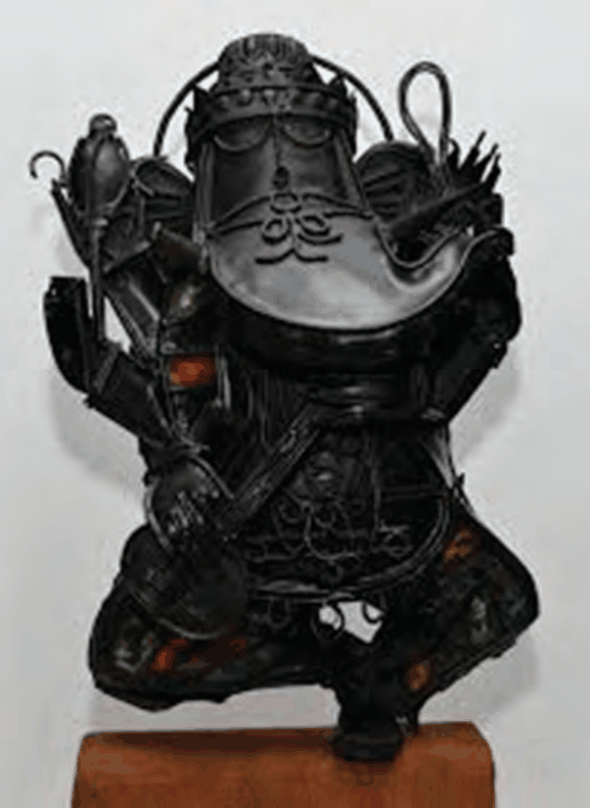
P. V. Janakiram made the metal sculpture Ganesha in 1970. Given below are two statements: one is labelled as Assertion (A) and the other is labelled as Reason (R).
Assertion (A): The image of Ganesha, crafted frontally, lends an important indigenous character of cave and temple sculpture.
Reason (R): Janakiram is influenced by the ancient temple sculpture of North India.
In the light of the above statements, choose the correct answer from the options given below:
Answer & explanation
Correct answer: option 3
The correct answer is Option (3) → (A) is true but (R) is false.
Assertion (A): The image of Ganesha, crafted frontally, lends an important indigenous character of cave and temple sculpture. — True. The frontal pose gives the copper Ganesha the indigenous character of cave and temple sculpture.
Reason (R): Janakiram is influenced by the ancient temple sculpture of North India. — False. Janakiram was influenced by the ancient temple sculpture of South India, not North India.
NCERT (2026-27): “Ganesha This is a sculpture in oxidised copper made by P. V. Janakiram in 1970, and is in the collection of NGMA, Delhi. … Janakiram is influenced by the ancient temple sculpture of South India. The image of Ganesha, crafted frontally, lends an important indigenous character of cave and temple sculpture. In this sculpture, Ganesha is palying vina, a musical instrument.”
|