
Statement I: Addition of a non-volatile solute to a volatile solvent raises the boiling point of the solvent.
Statement II: Addition of a non-volatile solute to a volatile solvent lowers the vapour pressure of the solvent.
Answer & explanation
Correct answer: option 1
The correct answer is Option (1) → Both Statement I and Statement II are correct and Statement II is the correct explanation of Statement I.
A liquid boils at the temperature at which its vapour pressure becomes equal to the atmospheric pressure.
Statement I: Addition of a non-volatile solute to a volatile solvent raises the boiling point of the solvent. — True. The boiling point of a solution is always higher than that of the pure solvent; this rise is the elevation of boiling point, ΔTb.
Statement II: Addition of a non-volatile solute to a volatile solvent lowers the vapour pressure of the solvent. — True. The non-volatile solute takes up part of the surface, so fewer solvent molecules escape and the vapour pressure falls.
Why Statement II explains Statement I? Because the solute lowers the vapour pressure, the solution must be heated to a higher temperature before its vapour pressure equals the atmospheric pressure. So the lowering of vapour pressure is the cause of the rise in boiling point.
NCERT (2026-27 edition):
1.6.2 Elevation of Boiling Point – “… We have also learnt in the last section that vapour pressure of the solvent decreases in the presence of non-volatile solute. … For example, the vapour pressure of an aqueous solution of sucrose is less than 1.013 bar at 373.15 K. In order to make this solution boil, its vapour pressure must be increased to 1.013 bar by raising the temperature above the boiling temperature of the pure solvent (water). Thus, the boiling point of a solution is always higher than that of the boiling point of the pure solvent in which the solution is prepared as shown in Fig. 1.7.”
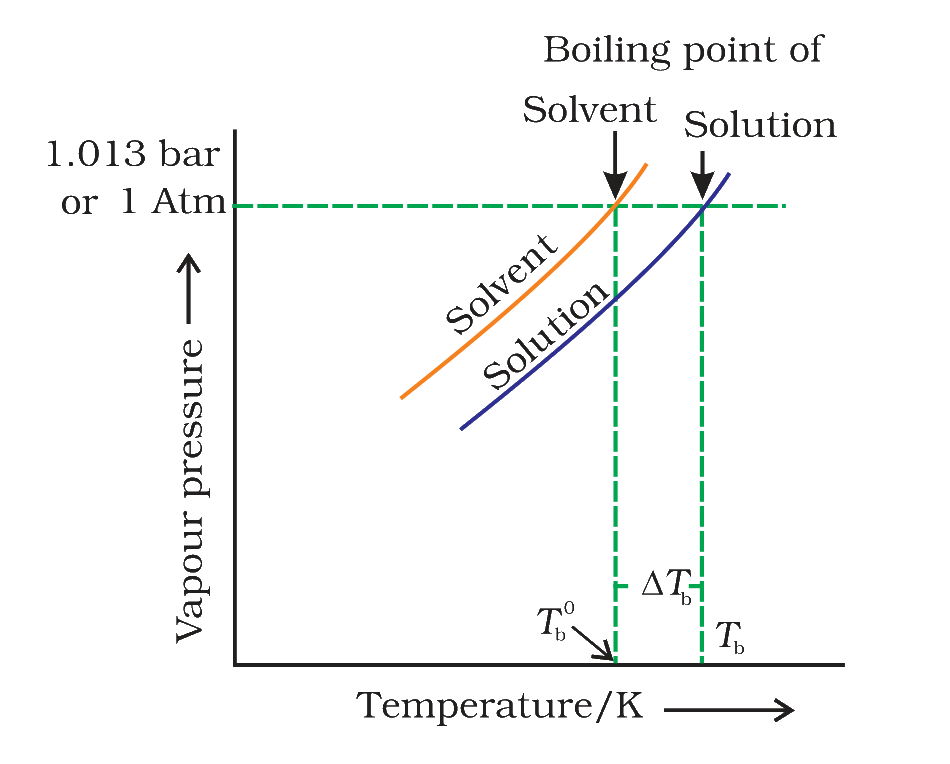
Fig. 1.7: The vapour pressure curve for solution lies below the curve for pure water. The diagram shows that ΔTb denotes the elevation of boiling point of a solvent in solution.