In which of the following compounds does the group attached to the benzene ring act as a deactivating and meta-directing group in electrophilic substitution reactions?
Answer & explanation
Correct answer: option 4
The correct answer is Option (4) → Acetophenone
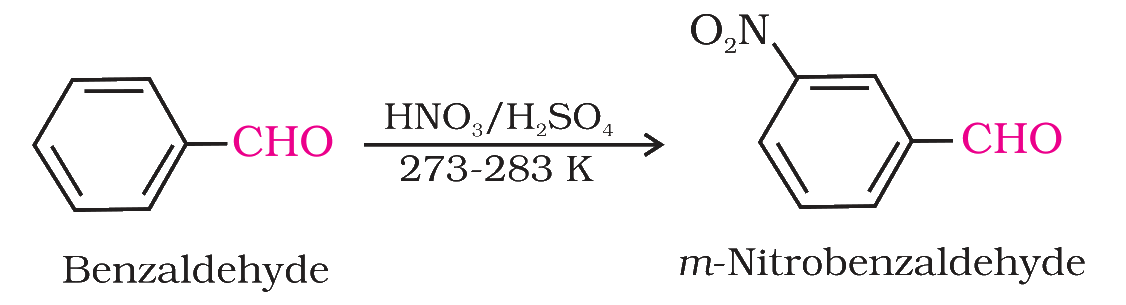
Acetophenone, C6H5COCH3, is an aromatic ketone. Its carbonyl group withdraws electrons from the benzene ring, so the ring reacts with electrophiles more slowly than benzene (deactivating), and the new group enters the meta position. Benzaldehyde behaves in the same way; its nitration gives m-nitrobenzaldehyde:
\( \displaystyle \ce{C6H5CHO} \xrightarrow[\text{273-283 K}]{\ce{HNO3}/\ce{H2SO4}} m\text{-}\ce{O2NC6H4CHO} \)
Why the other options are incorrect
Option (1) Chlorobenzene — Incorrect. The chlorine atom is slightly deactivating, but it directs the incoming group to the ortho and para positions.
Option (2) Phenol — Incorrect. The –OH group activates the ring and directs the incoming group to the ortho and para positions.
Option (3) Methoxybenzene — Incorrect. The –OCH3 group, like –OH, activates the ring and is ortho, para-directing.
NCERT (2026-27 edition):
8.4 Chemical Reactions – “(ii) Electrophilic substitution reaction: Aromatic aldehydes and ketones undergo electrophilic substitution at the ring in which the carbonyl group acts as a deactivating and meta-directing group.”